Book contents
- Frontmatter
- Contents
- List of contributors
- Preface
- List of abbreviations
- Sir Robert Yewdall Jennings, by Vaughan Lowe
- List of publications of Sir Robert Jennings
- Table of cases
- Part I The International Court of Justice
- Part II The sources and evidences of international law
- Part III Substance of international law
- Part IV Procedural aspects of the work of the International Court of Justice
- 21 Procedural law and the International Court of Justice
- 22 The President of the International Court of Justice
- 23 Nationality of claims: some relevant concepts
- 24 The plea of domestic jurisdiction before the International Court of Justice: substance or procedure?
- 25 ‘Partial’ judgments and the inherent jurisdiction of the International Court of Justice
- 26 Intervention before the International Court of Justice
- 27 The use of Chambers of the International Court of Justice
- 28 The use of experts by the International Court of Justice
- 29 Provisional measures
- 30 Remedies in the International Court of Justice
- 31 A comment on the current health of Advisory Opinions
- Part V The International Court of Justice and the United Nations
- Index
30 - Remedies in the International Court of Justice
Published online by Cambridge University Press: 02 November 2009
By

Book contents
- Frontmatter
- Contents
- List of contributors
- Preface
- List of abbreviations
- Sir Robert Yewdall Jennings, by Vaughan Lowe
- List of publications of Sir Robert Jennings
- Table of cases
- Part I The International Court of Justice
- Part II The sources and evidences of international law
- Part III Substance of international law
- Part IV Procedural aspects of the work of the International Court of Justice
- 21 Procedural law and the International Court of Justice
- 22 The President of the International Court of Justice
- 23 Nationality of claims: some relevant concepts
- 24 The plea of domestic jurisdiction before the International Court of Justice: substance or procedure?
- 25 ‘Partial’ judgments and the inherent jurisdiction of the International Court of Justice
- 26 Intervention before the International Court of Justice
- 27 The use of Chambers of the International Court of Justice
- 28 The use of experts by the International Court of Justice
- 29 Provisional measures
- 30 Remedies in the International Court of Justice
- 31 A comment on the current health of Advisory Opinions
- Part V The International Court of Justice and the United Nations
- Index
Summary
THE TOPIC
The remedies available in the International Court are a subject generally neglected in the literature of the law. The textbooks include a section of ‘modes of reparation’ but, of course, this is a related but different area of inquiry. This general neglect is difficult to explain. It cannot be laid at the door of civil law training because writers with a common law background show the same trait.
The principal purpose of this chapter in honour of my friend Sir Robert Jennings is to review the forms of judicial relief available. Familiar keywords will be employed in spite of the fact that such keywords may prove to be question-begging and freighted with unreliable implications. The familiar headings of declaratory judgments, actions for damages, and restitutio in integrum will therefore be used.
THE REMEDIAL COMPETENCE OF THE COURT
The competence of the Court to indicate remedies is based on article 36 of the Statute which indicates ‘the jurisdiction of the Court in all legal disputes concerning: … (d) the nature and extent of the reparation to be made for the breach of an international obligation’, in cases of compulsory jurisdiction by virtue of paragraph 2. No doubt the Court was expected to follow the practice of courts of arbitration in presuming a power to award damages and, apart from special agreement cases, the power of the Court to award damages has gone unquestioned.
Information
- Type
- Chapter
- Information
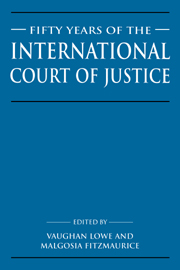
- Fifty Years of the International Court of JusticeEssays in Honour of Sir Robert Jennings, pp. 557 - 566Publisher: Cambridge University PressPrint publication year: 1996
Accessibility standard: Unknown
Why this information is here
This section outlines the accessibility features of this content - including support for screen readers, full keyboard navigation and high-contrast display options. This may not be relevant for you.Accessibility Information
Accessibility compliance for the PDF of this chapter is currently unknown
and may be updated in the future.
- 4
- Cited by