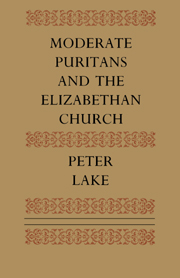
Book contents
- Frontmatter
- Contents
- Dedication
- Preface
- 1 Introduction: Laurence Chaderton and the problem of puritanism
- 2 Moderate beginnings: the case of Edward Dering
- 3 Chaderton's puritanism
- 4 The moderate puritan divine as anti-papal polemicist
- 5 Thomas Cartwright: the search for the centre and the threat of separation
- 6 William Whitaker's position as refracted through his anti-papal polemic
- 7 Theory into practice: puritan practical divinity in the 1580s and 1590s
- 8 William Whitaker at St John's: the puritan scholar as administrator
- 9 The theological disputes of the 1590s
- 10 Conformity: Chaderton's response to the Hampton Court Conference
- 11 William Bradshaw: moderation in extremity
- 12 Conclusion
- Notes
- Bibliography
- Index
2 - Moderate beginnings: the case of Edward Dering
Published online by Cambridge University Press: 16 October 2009
Book contents
- Frontmatter
- Contents
- Dedication
- Preface
- 1 Introduction: Laurence Chaderton and the problem of puritanism
- 2 Moderate beginnings: the case of Edward Dering
- 3 Chaderton's puritanism
- 4 The moderate puritan divine as anti-papal polemicist
- 5 Thomas Cartwright: the search for the centre and the threat of separation
- 6 William Whitaker's position as refracted through his anti-papal polemic
- 7 Theory into practice: puritan practical divinity in the 1580s and 1590s
- 8 William Whitaker at St John's: the puritan scholar as administrator
- 9 The theological disputes of the 1590s
- 10 Conformity: Chaderton's response to the Hampton Court Conference
- 11 William Bradshaw: moderation in extremity
- 12 Conclusion
- Notes
- Bibliography
- Index
Summary
In any account of moderate puritanism, in particular of moderate puritanism in the University of Cambridge, the obvious place to start is Christ's College and the obvious person to start with is Edward Dering. For it was with Dering, a fellow of Christ's College throughout the 1560s, that the foundations of the moderate puritan tradition were laid. Writing of Dering Professor Patrick Collinson has identified, as ‘the obsessive theme’ which ‘necessarily dominates any account of the man’, ‘the intense evangelical experience by a first generation protestant of justification and union with Christ through the renunciation of “will works” and of the world and the exercise of a lively faith’. It was this, together with a ‘consuming desire to convey this experience to others’, that produce Dering's ‘puritanism’. This, as Collinson concluded, ‘should serve as a reminder that much of what we call puritanism at this time was nothing but authentic protestantism and that the reign of Elizabeth was not conspicuously a post-reformation age … but the age of the English reformation par excellence when protestantism was for the first time taking a strong hold on families of the country gentry and the urban middle classes’. The passage is the basic text upon which this study is but an extended commentary.
Certainly Dering himself was well aware that he was living in no post-reformation era; that, in his own words, ‘scarce one of a great many can give an account of their faith’.
Information
- Type
- Chapter
- Information
- Moderate Puritans and the Elizabethan Church , pp. 16 - 24Publisher: Cambridge University PressPrint publication year: 1982
Accessibility standard: Unknown
Why this information is here
This section outlines the accessibility features of this content - including support for screen readers, full keyboard navigation and high-contrast display options. This may not be relevant for you.Accessibility Information
Accessibility compliance for the PDF of this chapter is currently unknown
and may be updated in the future.