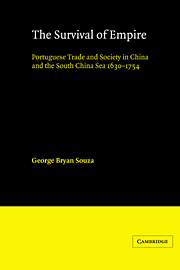
Book contents
- Frontmatter
- Contents
- List of figures, maps and tables
- Glossary
- Notes on spelling and currency, weights and measures
- Preface
- 1 Maritime trade in Asia
- 2 Imperial foundations: the Estado da India and Macao
- 3 Population, personalities, and communal power
- 4 Country traders and Crown monopoly
- 5 Merchants and markets
- 6 Country traders and the search for markets
- 7 Imperial relations: Macao and the Estado da India
- 8 Imperial survival: Sino-Portuguese relations from Ming to Ch'ing
- 9 Macao, Companies and country traders: the other Europeans in China
- 10 Conclusion
- List of abbreviations and notes
- Primary Sources
- Bibliography
- Index
1 - Maritime trade in Asia
Published online by Cambridge University Press: 24 October 2009
Book contents
- Frontmatter
- Contents
- List of figures, maps and tables
- Glossary
- Notes on spelling and currency, weights and measures
- Preface
- 1 Maritime trade in Asia
- 2 Imperial foundations: the Estado da India and Macao
- 3 Population, personalities, and communal power
- 4 Country traders and Crown monopoly
- 5 Merchants and markets
- 6 Country traders and the search for markets
- 7 Imperial relations: Macao and the Estado da India
- 8 Imperial survival: Sino-Portuguese relations from Ming to Ch'ing
- 9 Macao, Companies and country traders: the other Europeans in China
- 10 Conclusion
- List of abbreviations and notes
- Primary Sources
- Bibliography
- Index
Summary
Maritime trade in Asia antedates early modern history. During the fifteenth century, intrepid Chinese mariners and ships sailed into the Indian Ocean. Chinese produce was sold in Indian ports and shipped into the Red Sea, Persian Gulf or along the east African coast. By the end of the fifteenth century, Ming China's official interest in these commercial and political links with India and the Indian Ocean had collapsed. Maritime trade between China and India was sustained by junk traders sailing, principally, to Malacca and other ports in the South China Sea. At Malacca, the Chinese encountered and traded with other Asian merchants who frequented that port.
The Asian, Chinese, Indian, Arabian, Malay and non-Malay indigenous merchants who traded at Malacca met on the periphery of one geographical region in which the Chinese perceived themselves dominant. Those Chinese merchants did not concern themselves over the commercial and religious penetration by Islamic traders and missionaries throughout the Indonesian archipelago. Neither were they particularly preoccupied with the competitive commercial activities of the Malay and non-Malay indigenous merchants. Sinocentric attitudes led the Chinese merchants to ignore the maritime and commercial acumen of the many merchants of the Indian Ocean who were present at Malacca.
The Indian Ocean and the South China Sea are terms recently created by geographers to delineate the physical boundaries between three regions, the Indian sub-continent, Southeast Asia and China. Asian and European merchants of the early modern period would not recognise the Indian Ocean and the South China Sea as those terms are currently used.
Information
- Type
- Chapter
- Information
- The Survival of EmpirePortuguese Trade and Society in China and the South China Sea 1630–1754, pp. 1 - 11Publisher: Cambridge University PressPrint publication year: 1986
Accessibility standard: Unknown
Why this information is here
This section outlines the accessibility features of this content - including support for screen readers, full keyboard navigation and high-contrast display options. This may not be relevant for you.Accessibility Information
Accessibility compliance for the PDF of this chapter is currently unknown
and may be updated in the future.