Book contents
- Frontmatter
- Contents
- List of illustrations
- Preface
- List of abbreviations
- Notes on dates and transliteration
- Introduction
- 1 The historical background
- 2 The battle of ʿAyn Jālūt
- 3 The formulation of anti-Īlkhānid policy
- 4 The search for a second front
- 5 Military and diplomatic skirmishing
- 6 The secret war
- 7 Baybars's intervention in Seljuq Rūm
- 8 Baybars's posthumous victory: the second battle of Homs (680/1281)
- 9 The Mamluk–Īlkhānid frontier
- 10 Mamluks and Mongols: an overview
- Maps
- Genealogical Tables
- Glossary
- Bibliography
- Index
Introduction
Published online by Cambridge University Press: 23 November 2009

Book contents
- Frontmatter
- Contents
- List of illustrations
- Preface
- List of abbreviations
- Notes on dates and transliteration
- Introduction
- 1 The historical background
- 2 The battle of ʿAyn Jālūt
- 3 The formulation of anti-Īlkhānid policy
- 4 The search for a second front
- 5 Military and diplomatic skirmishing
- 6 The secret war
- 7 Baybars's intervention in Seljuq Rūm
- 8 Baybars's posthumous victory: the second battle of Homs (680/1281)
- 9 The Mamluk–Īlkhānid frontier
- 10 Mamluks and Mongols: an overview
- Maps
- Genealogical Tables
- Glossary
- Bibliography
- Index
Summary
The Mongols conquered the land and there came to them
From Egypt a Turk, who sacrificed his life.
In Syria he destroyed and scattered them.
To everything there is a pest of its own kind.
Abū Shāma (d. 1267)For sixty years, commencing in AD 1260, the Mamluks of Egypt and Syria were involved in a more or less constant struggle with the Īlkhānid Mongols of Persia. During this period, the Mongols made several concerted efforts to invade Syria: in AD 1260, 1281, 1299, 1300, 1303 and 1312. With one exception, all the Mongol expeditions were failures. Even the one Mongol victory on the field, at Wādī al-Khaznadār in AD 1299, did not lead to the permanent Mongol occupation of Syria and the ultimate defeat of the Mamluks, as the Mongols evacuated Syria after an occupation lasting only a few months. Between these major campaigns, the war generally continued in a form which in modern parlance might be described as a “cold war”: raids over both sides of the border, diplomatic maneuvers, espionage and other types of subterfuge, propaganda and ideological posturing, psychological warfare, use of satellite states, and attempts to build large-scale alliances against the enemy. Here, as in the major battles, the Mamluks usually maintained the upper hand. Yet, in spite of a conspicuous lack of success on the part of the Mongols, they continued to pursue their goals of conquering Syria and subjecting the Mamluks, until their efforts began to peter out towards the end of the second decade of the fourteenth century.
Information
- Type
- Chapter
- Information
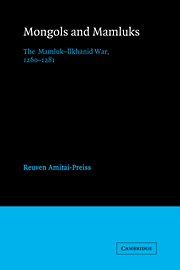
- Mongols and MamluksThe Mamluk-Ilkhanid War, 1260–1281, pp. 1 - 7Publisher: Cambridge University PressPrint publication year: 1995
Accessibility standard: Unknown
Why this information is here
This section outlines the accessibility features of this content - including support for screen readers, full keyboard navigation and high-contrast display options. This may not be relevant for you.Accessibility Information
Accessibility compliance for the PDF of this chapter is currently unknown
and may be updated in the future.