Book contents
- Frontmatter
- Contents
- Acknowledgments
- Introduction
- 1 Reconstructing the Aufbau
- 2 The problem of objectivity: An overview of Carnap's constitutional project
- 3 An outline of the constitutional projects for objectivity
- 4 The background to early Carnap: Themes from Kant
- 5 The fundamentals of neo-Kantian epistemology
- 6 Carnap's neo-Kantian origins: Der Raum
- 7 Critical conventionalism
- 8 Epistemology between logic and science: The essential tension
- 9 After objectivity: Logical empiricism as philosophy of science
- Bibliography
- Index
1 - Reconstructing the Aufbau
Published online by Cambridge University Press: 30 October 2009

Book contents
- Frontmatter
- Contents
- Acknowledgments
- Introduction
- 1 Reconstructing the Aufbau
- 2 The problem of objectivity: An overview of Carnap's constitutional project
- 3 An outline of the constitutional projects for objectivity
- 4 The background to early Carnap: Themes from Kant
- 5 The fundamentals of neo-Kantian epistemology
- 6 Carnap's neo-Kantian origins: Der Raum
- 7 Critical conventionalism
- 8 Epistemology between logic and science: The essential tension
- 9 After objectivity: Logical empiricism as philosophy of science
- Bibliography
- Index
Summary
there is no question that Rudolf Carnap's first major book, Der logische Aufbau der Welt (The logical structure of the world; hereafter Aufbau), published in 1928, is a central document of analytic philosophy. Its place has been secured by Carnap's general importance in setting the agenda for analytic philosophy from the late 1920s until his death in 1970. The Aufbau itself has been seen as perhaps the crucial document in the formation of the project of logical positivism. It is also Carnap's most sustained attempt to provide a general epistemology of empirical knowledge. Because of its historical role in shaping analytic philosophy generally and logical positivism in particular, many of the standard-bearers of analytic philosophy have had occasion to engage in interpretations of this book– often as a way of motivating their own philosophical enquiries. Among them we find Hillary Putnam, David Lewis, and, most importantly, Nelson Goodman and W. V. Quine. There is no better place to turn for a preliminary account of the epistemology put forward in Carnap's book than to the text itself. To fix certain points of reference, therefore, let us, without further ado, rehearse some of the principal themes of Carnap's epistemological project.
FUNDAMENTALS OF THE EPISTEMOLOGY OF THE AUFBAU
Der logische Aufbau der Welt begins with these words (§1): “The aim of the present investigations is the establishment of an epistemo-logical [erkenntnismassig-logischen] system of objects or concepts, the ‘constitutional system’” Two important points are then made. First, “object” is taken “in its widest possible sense, namely, for anything about which a statement can be made” (§1).
Information
- Type
- Chapter
- Information
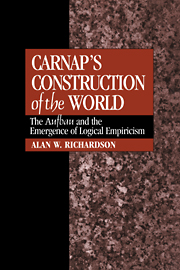
- Carnap's Construction of the WorldThe Aufbau and the Emergence of Logical Empiricism, pp. 5 - 30Publisher: Cambridge University PressPrint publication year: 1997
Accessibility standard: Unknown
Why this information is here
This section outlines the accessibility features of this content - including support for screen readers, full keyboard navigation and high-contrast display options. This may not be relevant for you.Accessibility Information
Accessibility compliance for the PDF of this chapter is currently unknown
and may be updated in the future.