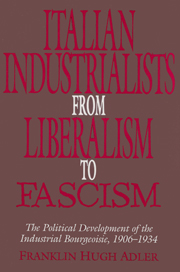
 Italian Industrialists from Liberalism to Fascism
 The Political Development of the Industrial Bourgeoisie, 1906–34
Book contents
- Frontmatter
- Contents
- Preface
- List of abbreviations
- Italian Industrialists from Liberalism to Fascism
- Introduction
- 1 Associational development during the Giolitti era
- 2 The First World War: a precorporatist experience
- 3 The postwar crisis and the rise of Fascism
- 4 Liberal–Fascism
- 5 Industrialists and nonintegral corporatism
- Conclusion
- Index
Conclusion
Published online by Cambridge University Press: 06 November 2009

Book contents
- Frontmatter
- Contents
- Preface
- List of abbreviations
- Italian Industrialists from Liberalism to Fascism
- Introduction
- 1 Associational development during the Giolitti era
- 2 The First World War: a precorporatist experience
- 3 The postwar crisis and the rise of Fascism
- 4 Liberal–Fascism
- 5 Industrialists and nonintegral corporatism
- Conclusion
- Index
Summary
Our study questions the adequacy of interpretations that either (1) reduce Fascism to the status of a class-specific project of the industrialists; (2) suggest a programmatic, psychological, or habitual affinity between industrialists and Fascism; or (3) presume determinate influence on the part of industrialists regarding the genesis and subsequent consolidation of Fascism.
To sustain the instrumentalist interpretation, one would have to specify a class-specific, distinctively authoritarian political alternative to the liberal state that industrialists self-consciously entertained, an end toward which Fascism was to be the requisite means. One would also have to demonstrate that the industrialists’ action-oriented principles, programmatic demands, and actual political practices were so informed and directed. This interpretation is clearly disconfirmed by the evidence.
So, too, are interpretations that suggest a programmatic, psychological, or habitual affinity between industrialists and Fascism. In contrast with the frequent, though undocumented, claim that Italian industrialists acted like padroni whose habits and attitudes toward production and workers were semifeudal and despotic, we have seen that industrial associations were grounded in a distinctively modern understanding of productive and syndical relations, based upon the most-advanced concepts regarding such relations at the time, including a clear recognition of the essential function workers’ syndicates were to play in modern labor relations and of the need to develop an institutionalized modus vivendi with them.
Our study questions the adequacy of interpretations that either reduce Fascism to the status of a class-specific project of the industrialists or presume their determinate influence in the rise and consolidation of Fascism.
Information
- Type
- Chapter
- Information
- Italian Industrialists from Liberalism to FascismThe Political Development of the Industrial Bourgeoisie, 1906–34, pp. 437 - 454Publisher: Cambridge University PressPrint publication year: 1995
Accessibility standard: Unknown
Why this information is here
This section outlines the accessibility features of this content - including support for screen readers, full keyboard navigation and high-contrast display options. This may not be relevant for you.Accessibility Information
Accessibility compliance for the PDF of this chapter is currently unknown
and may be updated in the future.