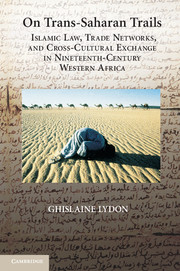
 On Trans-Saharan Trails
 Islamic Law, Trade Networks, and Cross-Cultural Exchange in Nineteenth-Century Western Africa
Book contents
- Frontmatter
- Contents
- Acknowledgments
- Note on Language
- List of Abbreviations
- Glossary
- Maps
- 1 “Making History” Across the African Divide
- 2 Trans-Saharan Trade in the Longue Durée
- 3 Markets and the Movement of Caravans: Nineteenth-Century Developments
- 4 Guelmīm and the Wād Nūn Traders
- 5 The Organization of Caravan Trade
- 6 Business Practice and Legal Culture in a Paper Economy of Faith
- 7 Trade Networks and the Limits of Cooperative Behavior
- 8 On Trans-Saharan Trails
- Appendix 1 Nineteenth-Century Events
- Appendix 2 Pillaged Caravans Reported in the Chronicles
- Bibliography
- Index
8 - On Trans-Saharan Trails
Published online by Cambridge University Press: 02 July 2009

Book contents
- Frontmatter
- Contents
- Acknowledgments
- Note on Language
- List of Abbreviations
- Glossary
- Maps
- 1 “Making History” Across the African Divide
- 2 Trans-Saharan Trade in the Longue Durée
- 3 Markets and the Movement of Caravans: Nineteenth-Century Developments
- 4 Guelmīm and the Wād Nūn Traders
- 5 The Organization of Caravan Trade
- 6 Business Practice and Legal Culture in a Paper Economy of Faith
- 7 Trade Networks and the Limits of Cooperative Behavior
- 8 On Trans-Saharan Trails
- Appendix 1 Nineteenth-Century Events
- Appendix 2 Pillaged Caravans Reported in the Chronicles
- Bibliography
- Index
Summary
Praise be to God, the one who imposed trustworthiness (amāna) between people and forbade all forms of betrayal. One cannot gain wealth if one does not have trust in people (lā māl liman lā thiqa lahu bi al-nās).
Understanding how the challenging feat was realized of conducting trans-Saharan caravan trade across perilously arid lands not ruled by a unifying state or regulated by a common currency is the principal aim of this book. By focusing on the institutional mechanisms that facilitated long-distance trade, namely, the place of the law, religion, and literacy, on the one hand, and trade network organizing, on the other, I hope to have come closer to this goal. The nineteenth century witnessed an increased volume of caravan traffic now more directly interconnected with European maritime trade. The proliferation of firearms and the increased availability of writing paper in this period were two factors that had a significant impact on the organization of camelback commerce. But aside from these developments, one question remains largely unanswered, namely, how commercial and legal institutions and practices may have been transformed in the course of time.
On the eve of the colonial period where this study ends, dramatic changes in the lives of long-distance traders were about to unfold. Before the end of the nineteenth century, some Wād Nūn merchants were forgoing the arduous Saharan crossings by embarking on European ships to transport goods, including horses, from Al-Ṣawīra to Ndar and back.
Information
- Type
- Chapter
- Information
- On Trans-Saharan TrailsIslamic Law, Trade Networks, and Cross-Cultural Exchange in Nineteenth-Century Western Africa, pp. 387 - 400Publisher: Cambridge University PressPrint publication year: 2009
Accessibility standard: Unknown
Why this information is here
This section outlines the accessibility features of this content - including support for screen readers, full keyboard navigation and high-contrast display options. This may not be relevant for you.Accessibility Information
Accessibility compliance for the PDF of this chapter is currently unknown
and may be updated in the future.
- 1
- Cited by