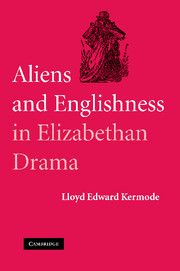
Book contents
- Frontmatter
- Contents
- Preface
- Acknowledgements
- 1 Introduction – aliens and the English in London
- 2 Discovering the alien in Elizabethan moral drama
- 3 Accommodating the alien in mid-Elizabethan London plays
- 4 Incorporating the alien in Shakespeare's second tetralogy
- 5 Being the alien in late-Elizabethan London plays
- Postscript: Early modern and post-modern alien excursions
- Notes
- Bibliography
- Index
1 - Introduction – aliens and the English in London
Published online by Cambridge University Press: 28 June 2009

Book contents
- Frontmatter
- Contents
- Preface
- Acknowledgements
- 1 Introduction – aliens and the English in London
- 2 Discovering the alien in Elizabethan moral drama
- 3 Accommodating the alien in mid-Elizabethan London plays
- 4 Incorporating the alien in Shakespeare's second tetralogy
- 5 Being the alien in late-Elizabethan London plays
- Postscript: Early modern and post-modern alien excursions
- Notes
- Bibliography
- Index
Summary
ALIENS, FOREIGNERS, CITIZENS
Tens of thousands of Continental migrants passed in and out of London and other major English towns during the reign of Elizabeth (1558–1603). The merchants of London were used to seeing aliens in their midst, Germans and Italians in particular being a significant presence since the twelfth century. But wars and military occupation in sixteenth-century northern Europe changed the complexion of the immigrant body in England. Protestants migrated in waves after the 1567 news of Alva's troop deployment to the Netherlands and after the fall of Antwerp in 1585, and a number of French Protestants made their way to England after the Paris Massacre of 1572. Edward VI had established French and Dutch churches in London in 1550, when the resident alien population of England was at its peak, and these institutions continued to act as religious, social, and organizational community centres for the immigrant population throughout the century. Among the religious refugees, however, were economic migrants, and this mixed group caused significant tension in the capital. On the one hand, the new residents brought new skills and stature to English production and trade. On the other hand, they were seen to be economically and ideologically dangerous: they clustered and traded among themselves, sent money abroad instead of reinvesting it in England, and practised religion that was influenced by extremists and attracted good members away from the Church of England.
Resentment against the aliens caused friction between English classes.
Information
- Type
- Chapter
- Information
- Aliens and Englishness in Elizabethan Drama , pp. 1 - 22Publisher: Cambridge University PressPrint publication year: 2009
Accessibility standard: Unknown
Why this information is here
This section outlines the accessibility features of this content - including support for screen readers, full keyboard navigation and high-contrast display options. This may not be relevant for you.Accessibility Information
Accessibility compliance for the PDF of this chapter is currently unknown
and may be updated in the future.