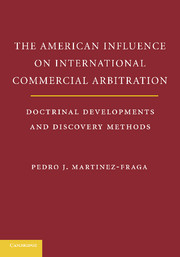
 The American Influences on International Commercial Arbitration
 Doctrinal Developments and Discovery Methods
Book contents
- Frontmatter
- Contents
- Table of Citations
- Acknowledgments
- Foreword
- Preface
- 1 Introduction
- 2 The Formation and Transformation of the Status of International and Domestic Arbitration in the United States
- 3 Wilko v. Swan, Scherk v. Alberto-Culver, and Mitsubishi v. Soler: Crafting a Level Playing Field
- 4 Procedural Change and 28 U.S.C. §1782: The Taking of Evidence v. Common Law Discovery
- 5 The Gathering of Evidence v. Common Law Discovery
- 6 What Has Really Happened? The Effects of a Trilogy Examined
- 7 The New Unorthodox Conception of Common Law Discovery in International Arbitration
- 8 And Now How Do We Avoid 28 U.S.C. Section 1782 in International Commercial Arbitration?
- 9 Perjury & Arbitration: The Honor System Where the Arbitrators Have the Honor and the Parties Have the System
- 10 Developments in the Apportionment of Jurisdiction Between Arbitrators and Courts Concerning the Validity of a Contract Containing an Arbitration Clause, and Transformations Regarding the Severability Doctrine
- 11 U.S. Arbitration Law and Its Dialogue with the New York Convention: The Development of Four Issues
- Conclusion
- Appendix A Duelo a Garrotazos
- Appendix B Selected Cases
- Appendix C The New York Convention, The Federal Arbitration Act, and 28 U.S.C. §1782
- Appendix D Amendments to 28 U.S.C. §1782
- Appendix E Selected Rules of Civil Procedure
- Appendix F Geneva Convention of 1927
- Appendix G Selections from the Legislative History of the Federal Arbitration Act
- Index
- References
6 - What Has Really Happened? The Effects of a Trilogy Examined
Published online by Cambridge University Press: 11 July 2009
Book contents
- Frontmatter
- Contents
- Table of Citations
- Acknowledgments
- Foreword
- Preface
- 1 Introduction
- 2 The Formation and Transformation of the Status of International and Domestic Arbitration in the United States
- 3 Wilko v. Swan, Scherk v. Alberto-Culver, and Mitsubishi v. Soler: Crafting a Level Playing Field
- 4 Procedural Change and 28 U.S.C. §1782: The Taking of Evidence v. Common Law Discovery
- 5 The Gathering of Evidence v. Common Law Discovery
- 6 What Has Really Happened? The Effects of a Trilogy Examined
- 7 The New Unorthodox Conception of Common Law Discovery in International Arbitration
- 8 And Now How Do We Avoid 28 U.S.C. Section 1782 in International Commercial Arbitration?
- 9 Perjury & Arbitration: The Honor System Where the Arbitrators Have the Honor and the Parties Have the System
- 10 Developments in the Apportionment of Jurisdiction Between Arbitrators and Courts Concerning the Validity of a Contract Containing an Arbitration Clause, and Transformations Regarding the Severability Doctrine
- 11 U.S. Arbitration Law and Its Dialogue with the New York Convention: The Development of Four Issues
- Conclusion
- Appendix A Duelo a Garrotazos
- Appendix B Selected Cases
- Appendix C The New York Convention, The Federal Arbitration Act, and 28 U.S.C. §1782
- Appendix D Amendments to 28 U.S.C. §1782
- Appendix E Selected Rules of Civil Procedure
- Appendix F Geneva Convention of 1927
- Appendix G Selections from the Legislative History of the Federal Arbitration Act
- Index
- References
Summary
The trilogy: Intel, In Re: Roz Trading Ltd., and In Re: Patrizio Clerici, engraft upon arbitration the very issues endemic to the policies underlying Section 1782(a); namely, the viability of the statute's twin objectives. Whether Section 1782(a) furthers the objective of proliferating among the community of nations the Federal Rules of Civil Procedure and promotes U.S. style discovery internationally, and (b) by so doing champions reciprocity in the field of judicial assistance among nations, certainly remains to be seen. A handful of commentators have observed that the use of Section 1782 empowers foreign litigants, and now parties to international arbitral proceedings, at the expense of U.S. citizens and businesses. Indeed, there is little evidence that Section 1782, in any context, has spawned an acceptance of U.S. common law discovery precepts or has in any way improved judicial cooperation among nations.
One inevitable question is whether the doctrinal development of incorporating discovery into arbitration proceedings constitutes progress or a stark defiance of the very principles that arbitration, at least theoretically, purports to further? The interminable and daunting nature of the intelligent and coherent contrasting points of view this question spawns should not detract from efforts to address it and, in so doing, look beyond the more readily apparent responses to the inquiry.
Information
- Type
- Chapter
- Information
- The American Influences on International Commercial ArbitrationDoctrinal Developments and Discovery Methods, pp. 62 - 66Publisher: Cambridge University PressPrint publication year: 2009
References
, PARTY AUTONOMY IN CHINESE INTERNATIONAL ARBITRATION: A COMMENT ON RECENT DEVELOPMENTS, 8 Am. Rev. Int'l Arb. 331 (1997)Google Scholar
, ARBITRAL & JUDICIAL DECISION: PARTY AUTONOMY AND IMPLIED CHOICE IN INTERNATIONAL COMMERCIAL ARBITRATION, 14 Am. Rev. Int'l Arb. 571 (2003)Google Scholar
, THE LIMITATIONS OF PARTY AUTONOMY IN ICSID ARBITRATION, 15 Am. Rev. Int'l Arb. 253 (2004)Google Scholar
, The Hague Choice of Court Convention: Validating Party Autonomy and Providing an Alternative to Arbitration, 53 Am. J. Comp. L. 543 (2005)CrossRefGoogle Scholar
, Contractual Choice of Law in Contracts of Adhesion and Party Autonomy, 41 Akron L. Rev. 123 (2008)Google Scholar
, American “Exceptionalism” and Comparative Procedure, 50 Am. J. Comp. L. 277, 294 (2002)CrossRefGoogle Scholar
, The Uncertain Fate of Evidentiary Transplants: Anglo-American and Continental Experiments, 45 Am. J. Comp. L. 839, 844 (1997)CrossRefGoogle Scholar
Accessibility standard: Unknown
Why this information is here
This section outlines the accessibility features of this content - including support for screen readers, full keyboard navigation and high-contrast display options. This may not be relevant for you.Accessibility Information
Accessibility compliance for the PDF of this chapter is currently unknown
and may be updated in the future.