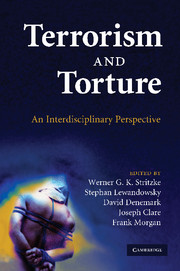
Book contents
- Frontmatter
- Contents
- List of figures
- List of tables
- List of contributors
- Preface
- 1 The terrorism–torture link: when evil begets evil
- 2 Torture, terrorism, and the moral prohibition on killing non-combatants
- 3 The equivalent logic of torture and terrorism: the legal regulation of moral monstrosity
- 4 War versus criminal justice in response to terrorism: the losing logic of torture
- 5 Reducing the opportunities for terrorism: applying the principles of situational crime prevention
- 6 From the terrorists' point of view: toward a better understanding of the staircase to terrorism
- 7 If they're not crazy, then what? The implications of social psychological approaches to terrorism for conflict management
- 8 The cycle of righteous destruction: a Terror Management Theory perspective on terrorist and counter-terrorist violence
- 9 Misinformation and the “War on Terror”: when memory turns fiction into fact
- 10 Icons of fear: terrorism, torture, and the media
- 11 What explains torture coverage during war-time? A search for realistic answers
- 12 Reversed negatives: how the news media respond to “our” atrocities
- 13 Terrorism and TV news coverage of the 2001 Australian election
- 14 Terrorism, anxiety, and war
- 15 I'm right, you're dead: speculations about the roots of fanaticism
- 16 Reducing terrorist risk: integrating jurisdictional and opportunity approaches
- Index
- References
2 - Torture, terrorism, and the moral prohibition on killing non-combatants
Published online by Cambridge University Press: 15 September 2009

Book contents
- Frontmatter
- Contents
- List of figures
- List of tables
- List of contributors
- Preface
- 1 The terrorism–torture link: when evil begets evil
- 2 Torture, terrorism, and the moral prohibition on killing non-combatants
- 3 The equivalent logic of torture and terrorism: the legal regulation of moral monstrosity
- 4 War versus criminal justice in response to terrorism: the losing logic of torture
- 5 Reducing the opportunities for terrorism: applying the principles of situational crime prevention
- 6 From the terrorists' point of view: toward a better understanding of the staircase to terrorism
- 7 If they're not crazy, then what? The implications of social psychological approaches to terrorism for conflict management
- 8 The cycle of righteous destruction: a Terror Management Theory perspective on terrorist and counter-terrorist violence
- 9 Misinformation and the “War on Terror”: when memory turns fiction into fact
- 10 Icons of fear: terrorism, torture, and the media
- 11 What explains torture coverage during war-time? A search for realistic answers
- 12 Reversed negatives: how the news media respond to “our” atrocities
- 13 Terrorism and TV news coverage of the 2001 Australian election
- 14 Terrorism, anxiety, and war
- 15 I'm right, you're dead: speculations about the roots of fanaticism
- 16 Reducing terrorist risk: integrating jurisdictional and opportunity approaches
- Index
- References
Summary
It is a curious fact that torture and terrorism tend to go hand in hand. When liberal states that would not normally use torture to extract information and confessions are confronted by terrorism, they are often tempted to use the very means that they would normally repudiate: examples include the UK in Northern Ireland, Spanish authorities in relation to the Basque separatist group Euskadi Ta Askatasuna (ETA), Israel and its various terrorist foes, the French authorities in Algeria, and the USA and its allies in the so-called “War on Terror.” The reverse also seems true; namely, far from stemming the tide of terrorism, the use of torture as a counter-terrorism tool seems to fan the flames. British repression in Northern Ireland coincided with the expansion of the IRA and the increased lethality of its violence. Images of torture at Abu Ghraib in Iraq have helped al-Qaeda recruiters and encouraged the radicalization of Islamic communities in various parts of the world. It is no coincidence, for example, that one of the perpetrators of the failed 2007 bomb attacks on British airports was an Iraqi angered by what he perceived as the mistreatment of his people by the Western occupiers.
This chapter seeks to explore the question of why terrorism and torture appear to be linked. I begin by considering the strategic-imperative argument – the claim that torture is a sometimes unfortunate but necessary response to “ticking bomb” terrorists, a lesser-evil scenario where governments are forced to chose between the rights of the suspected terrorist and the right of those whose life would be preserved by extracting the necessary information.
Information
- Type
- Chapter
- Information
- Terrorism and TortureAn Interdisciplinary Perspective, pp. 18 - 43Publisher: Cambridge University PressPrint publication year: 2009
References
(2004). Peace and war in the Middle East: a psychopolitical and sociocultural perspective. In and (eds.), Understanding Terrorism: Psychosocial Roots, Consequences and Interventions (pp.49–69). Washington, DC: American Psychological Association.Google Scholar
(2003). Terrorism and torture. International Journal of Applied Philosophy, 17, 355–373.CrossRefGoogle Scholar
Anon. (2004). Ashcroft: Hold torture memo. June 9. Agence France Presse. Retrieved March 28, 2005, from www.news24.com/News24/World/Iraq/0,6119,2–10–1460.
(2000). Stay the Hand of Vengeance: The Politics of War Crimes Tribunals. Princeton: Princeton University Press.Google Scholar
(2008). The Responsibility to Protect: The Global Effort to End Mass Atrocities. Cambridge: Polity.Google Scholar
, and (2002). Justice beyond orders? Australia and the International Criminal Court. Australian Journal of International Affairs, 56, 417–433.CrossRefGoogle Scholar
(1972). Bataille d'Alger, bataille de l'homme [Battle of Algiers, Battle of Man]. Paris: Desclée de Brouwer.Google Scholar
(1972). Interrogation in depth: the Compton and Parker reports. Modern Law Review, 35, 501–507.Google Scholar
(2005). Context of February 1995. Retrieved March 12, 2005, from www.cooperativeresearch.org/context/jsp?item.000293.thirdplot.html.
(1994). The Ethics of War and Peace: An Introduction to Legal and Moral Issues. Englewood Cliffs, NJ: Prentice Hall.Google Scholar
(2002). Terrorism, just war and supreme emergency. In and (eds.), Terrorism and Justice: Moral Argument in a Threatened World (pp. 33–50). Melbourne: Melbourne University Press.Google Scholar
(1971). Report of the Enquiry into Allegation against the Security Forces of Physical Brutality in Northern Ireland Arising out of Events on the 31st August 1971. London: HMSO.Google Scholar
(2000). Unspeakable Acts, Ordinary People: The Dynamics of Torture. New York: Alfred A. Knopf.Google Scholar
(2003). The problem of objectivity in definition. In D.J. Whittaker (ed.), The Terrorism Reader (2nd edn., pp. 7–18). London: Routledge.Google Scholar
(2003). Just War against Terror: The Burden of American Power in a Violent World. New York: Basic Books.Google Scholar
, and (1998). Preventing Torture: A Study of the European Convention for the Prevention of Torture and Inhuman Degrading Treatment and Punishment. Oxford: Oxford University Press.Google Scholar
(2004). British torture row envoy loses clearance for Uzbekistan post. October 12. Daily Telegraph.
(1966). Saint Augustine on war and killing: the problem of the innocent. Journal of the History of Ideas, 27, 195–204.CrossRefGoogle Scholar
(2003). Ages of Terror: What We Can and Can't Know about Terrorism. New York: Aldine de Gruyter.Google Scholar
(1945). Traité théorique et pratique de police judiciaire [Theory and Practice of Criminal Investigation]. Paris: Chapitne.Google Scholar
(1987). Report of the Commission of Enquiry into the Methods of Investigation of the General Security Service Regarding Hostile Terrorist Activity, Part I. Jerusalem: Government of Israel.Google Scholar
(1986). The Nazi Doctors: Medical Killing and the Psychology of Genocide. New York: Basic Books.Google Scholar
(1972). Ill-treatment, brutality and torture: some thoughts upon the “treatment” of Irish political prisoners. De Paul Law Review, 22, 553–581.Google Scholar
(2002). The torture controversy (1998–2002): towards a “new history” of the Algerian war?Modern and Contemporary France, 10, 449–459.CrossRefGoogle Scholar
(2005). Outsourcing torture. February 14. New Yorker, p. 3.
(2002). Filipino police unscover 1995 leads to September 11 plot. February 14. Christian Science Monitor, 489.Google Scholar
(1977). Torture and emergency powers under the European Convention of Human Rights: Ireland vs. United Kingdom. American Journal of International Law, 71, 897–907.CrossRefGoogle Scholar
(ed.) (1960). The Geneva Conventions of 12 August 1949 – Commentary: III Geneva Convention Relative to the Treatment of Prisoners of War. Geneva: ICRC.
(1998). The Republic (ed. and trans. ). Oxford: Oxford University Press.
(2004). Revealed: the full story of the Guantanamo Britons. March 14. Observer.
, and (eds.) (2001). Torture: A Crime against Humanity. Hong Kong: Asian Human Rights Commission.
(2003). Becoming a terrorist. In (ed.), Terrorists, Victims and Society: Psychological Perspectives on Terrorism and Its Consequences (pp. 29–53). London: Wiley.CrossRefGoogle Scholar
(2002). US decries abuse but defends interrogators. December 26. Washington Post, A12.
(2007). International Legitimacy: Contesting the Domestic Analogy. Ph.D. thesis, University of Melbourne.
(1977). Just and Unjust Wars: A Moral Argument with Historical Illustrations. New York: Basic Books.Google Scholar
(2002). Terrorism, counterterrorism and international law. Arab Studies Quarterly, 24, 11–24.Google Scholar
Accessibility standard: Unknown
Why this information is here
This section outlines the accessibility features of this content - including support for screen readers, full keyboard navigation and high-contrast display options. This may not be relevant for you.Accessibility Information
Accessibility compliance for the PDF of this chapter is currently unknown
and may be updated in the future.
- 1
- Cited by