Book contents
- Frontmatter
- Contents
- List of figures and table
- List of contributors
- 1 Introduction: Learning from Polanyi 1
- 2 Necessity or contingency: Mutuality and market
- 3 The great transformation of embeddedness: Karl Polanyi and the new economic sociology
- 4 The critique of the economic point of view: Karl Polanyi and the Durkheimians
- 5 Toward an alternative economy: Reconsidering the market, money, and value
- 6 Money in the making of world society
- 7 Debt, violence, and impersonal markets: Polanyian meditations
- 8 Whatever happened to householding?
- 9 Contesting The Great Transformation: Work in comparative perspective
- 10 “Sociological Marxism” in central India: Polanyi, Gramsci, and the case of the unions
- 11 Composites, fictions, and risk: toward an ethnography of price
- 12 Illusions of freedom: Polanyi and the third sector
- 13 Market and economy in environmental conservation in Jamaica
- 14 Embedded socialism? Land, labor, and money in eastern Xinjiang
- 15 Afterword: Learning from Polanyi 2
- Bibliography
- Index
10 - “Sociological Marxism” in central India: Polanyi, Gramsci, and the case of the unions
Published online by Cambridge University Press: 08 August 2009

Book contents
- Frontmatter
- Contents
- List of figures and table
- List of contributors
- 1 Introduction: Learning from Polanyi 1
- 2 Necessity or contingency: Mutuality and market
- 3 The great transformation of embeddedness: Karl Polanyi and the new economic sociology
- 4 The critique of the economic point of view: Karl Polanyi and the Durkheimians
- 5 Toward an alternative economy: Reconsidering the market, money, and value
- 6 Money in the making of world society
- 7 Debt, violence, and impersonal markets: Polanyian meditations
- 8 Whatever happened to householding?
- 9 Contesting The Great Transformation: Work in comparative perspective
- 10 “Sociological Marxism” in central India: Polanyi, Gramsci, and the case of the unions
- 11 Composites, fictions, and risk: toward an ethnography of price
- 12 Illusions of freedom: Polanyi and the third sector
- 13 Market and economy in environmental conservation in Jamaica
- 14 Embedded socialism? Land, labor, and money in eastern Xinjiang
- 15 Afterword: Learning from Polanyi 2
- Bibliography
- Index
Summary
The framing
In a suggestive recent article, Michael Burawoy (2003) discovers a complementarity and an at first sight unlikely convergence between Karl Polanyi and Antonio Gramsci. Though they came from different backgrounds, and had roots in the different Marxian traditions of Lukacs and Lenin, both broke with, and in comparable ways superseded, “Classical” Marxism. Taken together they lay the ground for the development of a rejuvenated and more “sociological” recension of the tradition. While most variants occlude society in their preoccupation with the state, the market, and their interrelations, they make it central to the analysis. Polanyi's focus is on the relationship between (“active”) society and the market; Gramsci's focus is on that between (“civil”) society and the state. But, crucially, they converge “on a similar conception of society as both the container of capitalism's contradictions and the terrain of its transcendence” (Burawoy 2003: 21–2). On Burawoy's reading, however, Gramsci has a more compelling analysis of “containment” than of “transcendence.” Polanyi provides genuine scope for a theory of counter-hegemony but is Pollyanna-ish about the obstacles to it.
Both reject the linear teleology of Classical Marxism and the mechanical determinism of the German Marxism of their day. History is not pre-ordained. “We can only know what is or has been, not what will be – for this does not exist, and is therefore by definition unknowable,” says Gramsci (quoted in Kolakowski 1981 3: 234).
Information
- Type
- Chapter
- Information
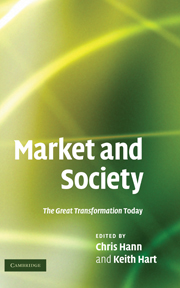
- Market and SocietyThe Great Transformation Today, pp. 175 - 202Publisher: Cambridge University PressPrint publication year: 2009
Accessibility standard: Unknown
Why this information is here
This section outlines the accessibility features of this content - including support for screen readers, full keyboard navigation and high-contrast display options. This may not be relevant for you.Accessibility Information
Accessibility compliance for the PDF of this chapter is currently unknown
and may be updated in the future.
- 19
- Cited by