Book contents
- Frontmatter
- Contents
- Preface
- Acknowledgements
- 1 Introduction
- 2 Structure of ice
- 3 Microstructure of natural ice features
- 4 Physical properties: elasticity, friction and diffusivity
- 5 Plastic deformation of the ice single crystal
- 6 Ductile behavior of polycrystalline ice: experimental data and physical processes
- 7 Modeling the ductile behavior of isotropic and anisotropic polycrystalline ice
- 8 Rheology of high-pressure and planetary ices
- 9 Fracture toughness of ice
- 10 Brittle failure of ice under tension
- 11 Brittle compressive failure of unconfined ice
- 12 Brittle compressive failure of confined ice
- 13 Ductile-to-brittle transition under compression
- 14 Indentation fracture and ice forces on structures
- 15 Fracture of the ice cover on the Arctic Ocean
- Index
Preface
Published online by Cambridge University Press: 01 February 2010

Book contents
- Frontmatter
- Contents
- Preface
- Acknowledgements
- 1 Introduction
- 2 Structure of ice
- 3 Microstructure of natural ice features
- 4 Physical properties: elasticity, friction and diffusivity
- 5 Plastic deformation of the ice single crystal
- 6 Ductile behavior of polycrystalline ice: experimental data and physical processes
- 7 Modeling the ductile behavior of isotropic and anisotropic polycrystalline ice
- 8 Rheology of high-pressure and planetary ices
- 9 Fracture toughness of ice
- 10 Brittle failure of ice under tension
- 11 Brittle compressive failure of unconfined ice
- 12 Brittle compressive failure of confined ice
- 13 Ductile-to-brittle transition under compression
- 14 Indentation fracture and ice forces on structures
- 15 Fracture of the ice cover on the Arctic Ocean
- Index
Summary
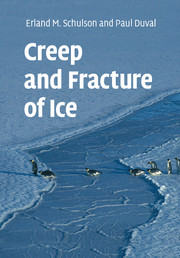
The purpose of this book is to discuss the creep and fracture of ice and the transition from ductile to brittle behavior in terms of underlying physical mechanisms. Accordingly, the book focuses on ice as a material, particularly on low-pressure or ordinary ice, and proceeds to describe the relationship between structure and mechanical properties, including elasticity. It reviews observations and measurements and then interprets them, generally in terms of concepts that have been developed to explain the deformation of other crystalline materials. Occasionally, new physical mechanisms are introduced, which appear not to be limited to ice. The creep behavior of both the ice crystal and the polycrystal is described. A brief description is given of some polycrystal models developed by the materials science community for the computation of the mechanical behavior of the ice polycrystal. A short analysis of the creep behavior of high-pressure ices is also made. The understanding of creep is applied to the deformation of glaciers and ice sheets, and of fracture, to ice forces on engineered structures and to the break-up of the sea ice cover on the Arctic Ocean. Passing reference is made to certain satellites within the outer Solar System and their icy crusts. Unanswered questions are noted, as is controversy.
Although some knowledge of materials science would be helpful, none is assumed. The book begins with a discussion of structure – crystal structure, defect structure and microstructure – and describes the elements that are fundamental to understanding creep and fracture.
Information
- Type
- Chapter
- Information
- Creep and Fracture of Ice , pp. xiPublisher: Cambridge University PressPrint publication year: 2009
Accessibility standard: Unknown
Why this information is here
This section outlines the accessibility features of this content - including support for screen readers, full keyboard navigation and high-contrast display options. This may not be relevant for you.Accessibility Information
Accessibility compliance for the PDF of this chapter is currently unknown
and may be updated in the future.