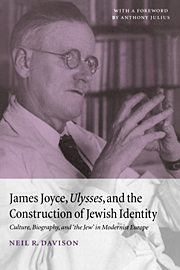
 James Joyce, Ulysses, and the Construction of Jewish Identity
 Culture, Biography, and 'the Jew' in Modernist Europe
Book contents
- Frontmatter
- Contents
- Foreword by Anthony Julius
- Acknowledgements
- List of abbreviations
- Introduction
- 1 Silence: family values
- 2 Silence: Jesuit years – Clongowes and Belvedere
- 3 Silence: university years – the Church, Dreyfus, and aesthetics
- 4 Exile: excursion to the Continent, bitter return
- 5 Cunning and exile: Greeks and Jews
- 6 Cunning: Jews and the Continent – texts and subtexts
- 7 Cunning: the miracle of Lazarus times two – Joyce and Italo Svevo
- 8 Ulysses
- Conclusion
- Notes
- Select bibliography
- Index
7 - Cunning: the miracle of Lazarus times two – Joyce and Italo Svevo
Published online by Cambridge University Press: 05 April 2012
Foreword by

Book contents
- Frontmatter
- Contents
- Foreword by Anthony Julius
- Acknowledgements
- List of abbreviations
- Introduction
- 1 Silence: family values
- 2 Silence: Jesuit years – Clongowes and Belvedere
- 3 Silence: university years – the Church, Dreyfus, and aesthetics
- 4 Exile: excursion to the Continent, bitter return
- 5 Cunning and exile: Greeks and Jews
- 6 Cunning: Jews and the Continent – texts and subtexts
- 7 Cunning: the miracle of Lazarus times two – Joyce and Italo Svevo
- 8 Ulysses
- Conclusion
- Notes
- Select bibliography
- Index
Summary
The basic facts of Joyce's friendship with Schmitz were first presented in the original Ellmann biography (1959). But while references to Schmitz as a model for Bloom have since become standard fare in Joyce studies, Svevo's status as a literary artist whose work influenced Joyce's constructions of “the Jew” has largely been ignored. Joyce's pre-Ulysses reading of Svevo's first two novels indeed begs investigation as a central moment of the former's awareness of how a character can embody a certain “Jewishness” without the necessary attributes of Halachic Jewish identity. To understand this intertextual influence, however, Svevo's own sense of “Jewishness,” as one who was raised in a Catholic culture, eventually converted to that religion, and yet professed atheism throughout his life, must be grasped. This chapter thus reviews Svevo's Jewish background and adult perception of his Jewish identity, the fortuitous meeting of Joyce and Schmitz, and finally the influence of the older Triestine's work on the younger Irishman.
As an outcome of the reputation he earned through his Berlitz tutorials, Joyce began in 1907 to tutor Schmitz, at the time an unread Triestine novelist who had written under the pseudonym “Italo Svevo.” Within two years of that meeting, however, Schmitz would play a critical role in the completion of A Portrait. But Schmitz's advice about the composition of A Portrait was only one of many positive outcomes of the relationship between himself and Joyce. From the beginning, the younger tutor and older student discovered they had an unexpected rapport. Schmitz's wife, Livia, explained that Joyce was delighted to find in Schmitz “a mentality similar to his own, an analytic method he found congenial.”
Information
- Type
- Chapter
- Information
- James Joyce, Ulysses, and the Construction of Jewish IdentityCulture, Biography, and 'the Jew' in Modernist Europe, pp. 155 - 184Publisher: Cambridge University PressPrint publication year: 1996
Accessibility standard: Unknown
Why this information is here
This section outlines the accessibility features of this content - including support for screen readers, full keyboard navigation and high-contrast display options. This may not be relevant for you.Accessibility Information
Accessibility compliance for the PDF of this chapter is currently unknown
and may be updated in the future.