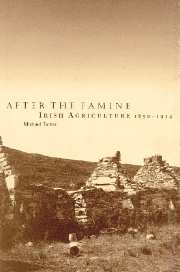
Book contents
- Frontmatter
- Contents
- List of figures
- List of tables
- Preface and acknowledgements
- 1 Introduction: Ireland and Irish agricultural history in context
- 2 Agricultural change
- 3 The occupation of the land
- 4 The product of the land: output
- 5 The performance of agriculture
- 6 Labour and the working of the land
- 7 Conclusion – structure, output and performance, and the distribution of the spoils
- Appendixes: A note on the origin of the data
- Appendix 1 Annual agricultural statistics, 1847–1914
- Appendix 2 Crop yields in Ireland, 1847–1914
- Appendix 3 Landholding and land occupancy distribution, 1847–1914
- Appendix 4 Irish agricultural prices
- Appendix 5 Weighting procedures adopted in estimating agricultural output
- Appendix 6 Richard Barrington of Fassaroe, County Wicklow
- Bibliography
- Index
6 - Labour and the working of the land
Published online by Cambridge University Press: 09 November 2009

Book contents
- Frontmatter
- Contents
- List of figures
- List of tables
- Preface and acknowledgements
- 1 Introduction: Ireland and Irish agricultural history in context
- 2 Agricultural change
- 3 The occupation of the land
- 4 The product of the land: output
- 5 The performance of agriculture
- 6 Labour and the working of the land
- 7 Conclusion – structure, output and performance, and the distribution of the spoils
- Appendixes: A note on the origin of the data
- Appendix 1 Annual agricultural statistics, 1847–1914
- Appendix 2 Crop yields in Ireland, 1847–1914
- Appendix 3 Landholding and land occupancy distribution, 1847–1914
- Appendix 4 Irish agricultural prices
- Appendix 5 Weighting procedures adopted in estimating agricultural output
- Appendix 6 Richard Barrington of Fassaroe, County Wicklow
- Bibliography
- Index
Summary
Introduction
When the literature on post-Famine Ireland is reviewed to seek a link between labour supply and changing agricultural production, it reveals a series of essentially conflicting stories and interpretations. The basic choices are of two sorts: was there a shortage of labour as a consequence of the mid-century crisis which determined changes in production out of tillage and into livestock; or was there a change in the terms of trade between tillage and livestock production which enhanced livestock production, independent initially of labour supply issues, but which then necessarily was labour saving, and therefore in turn led to people leaving the land; or was there a combination of the two? In this chapter this literature is reviewed, before the empirical exercise which confronts some of these issues is presented.
Conflicting models: labour constraint or market forces?
The demonstrable switch in emphasis in Irish agriculture from tillage to pasture after the Famine has been directly associated in official papers with a decline in labour supply. The clearest statement of this is contained in the comment by William Coyne, the Superintendent of Statistics at the Department of Agriculture, in his introduction to the 1901 Agricultural Statistics.
Adverting to the continuing contraction of the arable land of the country – this is, of course, the outstanding feature of these returns, especially when the process is regarded, not from year to year, but as an historical tendency.
Information
- Type
- Chapter
- Information
- After the FamineIrish Agriculture, 1850–1914, pp. 161 - 195Publisher: Cambridge University PressPrint publication year: 1996
Accessibility standard: Unknown
Why this information is here
This section outlines the accessibility features of this content - including support for screen readers, full keyboard navigation and high-contrast display options. This may not be relevant for you.Accessibility Information
Accessibility compliance for the PDF of this chapter is currently unknown
and may be updated in the future.