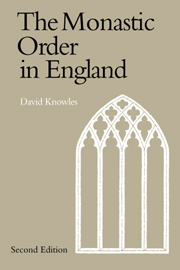
 The Monastic Order in England
 A History of its Development from the Times of St Dunstan to the Fourth Lateran Council 940–1216
Book contents
- Frontmatter
- GLASTONBURY FROM THE AIR
- Contents
- PREFACE TO THE SECOND EDITION
- PREFACE TO THE FIRST EDITION
- LIST OF ABBREVIATIONS
- Part One Historical
- I The Rule of Saint Benedict
- II The monastic order between the death of Saint Benedict and the times of Saint Dunstan
- III The monastic revival under Dunstan and King Edgar: the Regularis Concordia
- IV English monasticism between Dunstan and the Conquest
- V The Norman monasticism
- VI The Norman plantation
- VII The development of the religious life between 1066 and 1100
- VIII The Cluniacs in England
- IX Worcester, Evesham and the northern revival
- X The English monasteries under Henry I
- XI The new orders
- XII The new model of Cîteaux
- XIII The Cistercians in England: I. The first foundations
- XIV The Cistercians in England: II. The period of expansion
- XV The black monks between 1135 and 1175
- XVI Cluniac influence: Henry of Blois and Gilbert Foliot
- XVII The black monks from 1175 to 1216
- XVIII The hostility of the bishops towards the black monks
- XIX The case of Evesham
- XX The Cistercians from 1153 to 1216
- XXI The reign of John and the Fourth Lateran Council, 1199–1216
- XXII The Charterhouse of Witham and Hugh of Avalon
- Part Two Institutional
- Appendices
- Tables
- BIBLIOGRAPHY
- ADDITIONAL BIBLIOGRAPHY
- ADDITIONAL NOTES
- INDEX
XVIII - The hostility of the bishops towards the black monks
Published online by Cambridge University Press: 04 May 2010
Book contents
- Frontmatter
- GLASTONBURY FROM THE AIR
- Contents
- PREFACE TO THE SECOND EDITION
- PREFACE TO THE FIRST EDITION
- LIST OF ABBREVIATIONS
- Part One Historical
- I The Rule of Saint Benedict
- II The monastic order between the death of Saint Benedict and the times of Saint Dunstan
- III The monastic revival under Dunstan and King Edgar: the Regularis Concordia
- IV English monasticism between Dunstan and the Conquest
- V The Norman monasticism
- VI The Norman plantation
- VII The development of the religious life between 1066 and 1100
- VIII The Cluniacs in England
- IX Worcester, Evesham and the northern revival
- X The English monasteries under Henry I
- XI The new orders
- XII The new model of Cîteaux
- XIII The Cistercians in England: I. The first foundations
- XIV The Cistercians in England: II. The period of expansion
- XV The black monks between 1135 and 1175
- XVI Cluniac influence: Henry of Blois and Gilbert Foliot
- XVII The black monks from 1175 to 1216
- XVIII The hostility of the bishops towards the black monks
- XIX The case of Evesham
- XX The Cistercians from 1153 to 1216
- XXI The reign of John and the Fourth Lateran Council, 1199–1216
- XXII The Charterhouse of Witham and Hugh of Avalon
- Part Two Institutional
- Appendices
- Tables
- BIBLIOGRAPHY
- ADDITIONAL BIBLIOGRAPHY
- ADDITIONAL NOTES
- INDEX
Summary
The last quarter of the twelfth century and the first decade of the thirteenth, or, to speak more accurately, the period between the death of Alexander III in 1181 and the Fourth Lateran Council of 1215, was a time of considerable disorder in the life of the Church in western Europe. Under a succession of short-lived and undistinguished popes the apostolic see lost the power of initiative and direction at the very moment when the great spiritual revival of the first half of the century was exhausted, while the intellectual renaissance, theological, legal and secular, was finding foci of growing importance at a number of widely separated points which were to become the medieval universities; at the same time the movement towards corporate, autonomous life, in the centres both of learning and of commerce, was developing very rapidly, and affecting the outlook of all groups and associations. There were, in fact, within the framework of the Church and nation, strong centrifugal forces drawing away from the central government towards lesser and more communal forms of control and association.
In England, this disorganization in the ecclesiastical sphere was increased by the trend taken by national events. The autocratic, strongly national government of Henry II had to a large extent withdrawn England in practice, though not in theory, from the control of the Curia and canon law; the group of curial, canonist bishops of the middle of the century had been succeeded by one composed of men less distinguished in themselves, with little experience of affairs outside the country, and appointed for the most part from the clergy surrounding the court; the absentee Richard I was succeeded by John, under whom all rational direction of affairs ceased and a complete and lasting rupture with the papacy ensued.
Information
- Type
- Chapter
- Information
- The Monastic Order in EnglandA History of its Development from the Times of St Dunstan to the Fourth Lateran Council 940–1216, pp. 313 - 330Publisher: Cambridge University PressPrint publication year: 1963
Accessibility standard: Unknown
Why this information is here
This section outlines the accessibility features of this content - including support for screen readers, full keyboard navigation and high-contrast display options. This may not be relevant for you.Accessibility Information
Accessibility compliance for the PDF of this chapter is currently unknown
and may be updated in the future.
- 1
- Cited by