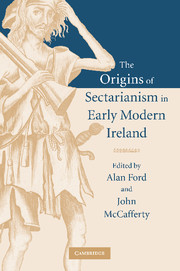
Book contents
- Frontmatter
- Contents
- Preface
- List of contributors
- List of abbreviations
- 1 Living together, living apart: sectarianism in early modern Ireland
- 2 Confessionalisation in Ireland: periodisation and character, 1534–1649
- 3 Protestant prelates or godly pastors? The dilemma of the early Stuart episcopate
- 4 ‘In imitation of that holy patron of prelates the blessed St Charles’: episcopal activity in Ireland and the formation of a confessional identity, 1618–1653
- 5 A haven of popery: English Catholic migration to Ireland in the age of plantations
- 6 The Irish historical renaissance and the shaping of Protestant history
- 7 Religion, culture and the bardic elite in early modern Ireland
- 8 The political and religious thought of Florence Conry and Hugh McCaughwell
- 9 Sectarianism: division and dissent in Irish Catholicism
- 10 Purity of blood and purity of faith in early modern Ireland
- 11 Concluding reflection: confronting the violence of the Irish reformations
- Index
9 - Sectarianism: division and dissent in Irish Catholicism
Published online by Cambridge University Press: 24 November 2009

Book contents
- Frontmatter
- Contents
- Preface
- List of contributors
- List of abbreviations
- 1 Living together, living apart: sectarianism in early modern Ireland
- 2 Confessionalisation in Ireland: periodisation and character, 1534–1649
- 3 Protestant prelates or godly pastors? The dilemma of the early Stuart episcopate
- 4 ‘In imitation of that holy patron of prelates the blessed St Charles’: episcopal activity in Ireland and the formation of a confessional identity, 1618–1653
- 5 A haven of popery: English Catholic migration to Ireland in the age of plantations
- 6 The Irish historical renaissance and the shaping of Protestant history
- 7 Religion, culture and the bardic elite in early modern Ireland
- 8 The political and religious thought of Florence Conry and Hugh McCaughwell
- 9 Sectarianism: division and dissent in Irish Catholicism
- 10 Purity of blood and purity of faith in early modern Ireland
- 11 Concluding reflection: confronting the violence of the Irish reformations
- Index
Summary
Historians are predisposed to view the counter-reformation as a uniform ideology. This is clear from the descriptive canon that has been adopted generally. The counter-reformation is vigorous, rigorous and aggressive: a coherent ideology propagated with missionary fervour by a cadre of disciplined ascetic scholars spearheading the new world order. We are less inclined to view it as a complex and nuanced episode in the development of Catholicism from universal world church to denomination. This was a journey littered with internal controversy and dispute, and was characterised by a denial of an increasingly sectarian profile.
Catholic Europe may have been diverted from the realities of rejection and confessional diversity at home by the successful propagation of the faith among the native peoples of the American and Asian colonies. However, by focusing on the success of the counter-reformation as mission, historians have effectively turned their backs on the counter-reformation church as institution, and on the internal tensions and jurisdictional conflicts that are at the heart of any institution. The purpose of this chapter is to explore this tension.
The subject matter is a local dispute between the vicar general of Armagh and ordinary of Drogheda and the Franciscans based in that town. The dispute is well known and the documentation detailed. It gives us a glimpse of Catholic life in Drogheda in the period 1618–25. Although unapologetically local, the dispute has a general significance for Irish Catholicism.
Information
- Type
- Chapter
- Information
- The Origins of Sectarianism in Early Modern Ireland , pp. 203 - 215Publisher: Cambridge University PressPrint publication year: 2005
Accessibility standard: Unknown
Why this information is here
This section outlines the accessibility features of this content - including support for screen readers, full keyboard navigation and high-contrast display options. This may not be relevant for you.Accessibility Information
Accessibility compliance for the PDF of this chapter is currently unknown
and may be updated in the future.
- 1
- Cited by