Book contents
- Frontmatter
- Contents
- Foreword
- Acknowledgments
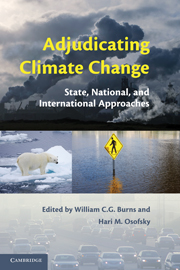
- Adjudicating Climate Change
- 1 Overview: The Exigencies That Drive Potential Causes of Action for Climate Change
- PART I SUBNATIONAL CASE STUDIES
- PART II NATIONAL CASE STUDIES
- PART III SUPRANATIONAL CASE STUDIES
- 11 The World Heritage Convention and Climate Change: The Case for a Climate-Change Mitigation Strategy beyond the Kyoto Protocol
- 12 The Inuit Petition as a Bridge? Beyond Dialectics of Climate Change and Indigenous Peoples' Rights
- 13 Bringing Climate Change Claims to the Accountability Mechanisms of International Financial Institutions
- 14 Potential Causes of Action for Climate Change Impacts under the United Nations Fish Stocks Agreement
- 15 Climate Change Litigation: Opening the Door to the International Court of Justice
- 16 The Implications of Climate Change Litigation: Litigation for International Environmental Law-Making
- 17 Conclusion: Adjudicating Climate Change across Scales
- Index
- References
11 - The World Heritage Convention and Climate Change: The Case for a Climate-Change Mitigation Strategy beyond the Kyoto Protocol
Published online by Cambridge University Press: 25 August 2009

Book contents
- Frontmatter
- Contents
- Foreword
- Acknowledgments
- Adjudicating Climate Change
- 1 Overview: The Exigencies That Drive Potential Causes of Action for Climate Change
- PART I SUBNATIONAL CASE STUDIES
- PART II NATIONAL CASE STUDIES
- PART III SUPRANATIONAL CASE STUDIES
- 11 The World Heritage Convention and Climate Change: The Case for a Climate-Change Mitigation Strategy beyond the Kyoto Protocol
- 12 The Inuit Petition as a Bridge? Beyond Dialectics of Climate Change and Indigenous Peoples' Rights
- 13 Bringing Climate Change Claims to the Accountability Mechanisms of International Financial Institutions
- 14 Potential Causes of Action for Climate Change Impacts under the United Nations Fish Stocks Agreement
- 15 Climate Change Litigation: Opening the Door to the International Court of Justice
- 16 The Implications of Climate Change Litigation: Litigation for International Environmental Law-Making
- 17 Conclusion: Adjudicating Climate Change across Scales
- Index
- References
Summary
INTRODUCTION
Between 2004 and 2006, nongovernmental organizations (NGOs) from several countries submitted four petitions and a report (collectively, the Petitions) to the World Heritage Committee to list certain World Heritage sites on the “List of World Heritage in Danger” (the “in danger” list) because of the deterioration these sites have endured as a result of climate change. These sites include Sagarmatha National Park in Nepal, Huascarán National Park in Peru, the Great Barrier Reef in Australia, Waterton-Glacier International Peace Park in the United States and Canada, and Belize's Barrier Reef Reserve System, which suffer from two of the most dramatic effects of climate change on natural areas – coral bleaching and glacial ice loss. The Petitions argue that pursuant to their obligations under the World Heritage Convention (WHC), State Parties must develop a mitigation strategy that prevents anthropogenic interference with the climate system sufficient to halt further deterioration of World Heritage sites threatened by climate change. At the heart of the Petitions, then, is a call for all State Parties to the WHC to make drastic cuts in their greenhouse gas emissions.
The World Heritage Committee first considered the Petitions, except the petition concerning Waterton-Glacier International Peace Park (Waterton-Glacier), at its regular meeting in Durban, South Africa, during July 2005. The Committee adopted a decision recognizing the threat climate change poses to the integrity of World Heritage sites.
Information
- Type
- Chapter
- Information
- Adjudicating Climate ChangeState, National, and International Approaches, pp. 255 - 271Publisher: Cambridge University PressPrint publication year: 2009
References
Millennium Ecosystem Assessment, Ecosystems and Human Well-being: Current State and Trends 379 (, , & eds., 2005)
, An International Legal Regime for Protected Areas, in IUCN Environmental Law & Policy Paper No. 49, 23 ( & , eds. 2004)Google Scholar
, The Meaning and the Range of the Norm Pacta Sunt Servanda, 39 Am. J. Intl. l.180 (1945)CrossRefGoogle Scholar
, The Vienna Convention on the Law of Treaties Before United States Courts, 28 Va. J. int'l L. 281, 298 (1988)Google Scholar
, The Law and Procedure of the International Court of Justice 1951–1954, 33 Brit. Y.B. Int'l. L. 203, 204 (1957)Google Scholar
, Travaux Preparatoires for the UNESCO World Heritage Convention, 2 Earth L.J.45, 53 (1972)Google Scholar
, The Law of Procedure of the International Court of Justice: Treaty Interpretation and Other Treaty Points, 28 Brit. Y.B. Int'l. L.1, 4 (1951)Google Scholar
, The Unresolved Debates that Scorched Kyoto: An Analytical Framework, 13 U. Miami Int'l & Comp. L. Rev.233, 251 (2005)Google Scholar
, Kyoto or Not, Here We Come: The Promise and Perils of Piecemeal Approach to Climate Change Regulation in the United States, 15 Cornell J. L. & Pub. Pol'y369 (2006)Google Scholar
Millennium Ecosystem Assessment, Ecosystems and Human Well-being: Policy Responses375 ( et al. eds., 2005)
, Common but Differentiated Responsibility: The Kyoto Protocol and United States Policy, 7 N.Y.U. Envtl. L.J. 27 (1999)Google Scholar
Accessibility standard: Unknown
Why this information is here
This section outlines the accessibility features of this content - including support for screen readers, full keyboard navigation and high-contrast display options. This may not be relevant for you.Accessibility Information
Accessibility compliance for the PDF of this chapter is currently unknown
and may be updated in the future.
- 1
- Cited by