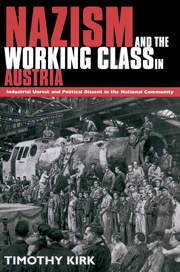
 Nazism and the Working Class in Austria
 Industrial Unrest and Political Dissent in the 'National Community'
Book contents
- Frontmatter
- Contents
- List of tables
- Acknowledgements
- Maps
- Introduction
- 1 Austrian fascisms, ‘Austrofascism’ and the working class
- 2 Economic integration and political opposition between the Anschluss and the war
- 3 The war economy and the changing workforce 1939–1945
- 4 Work discipline in the war economy
- 5 Popular opinion and political protest in working-class communities
- Conclusion
- Notes
- Select bibliography
- Index
Book contents
- Frontmatter
- Contents
- List of tables
- Acknowledgements
- Maps
- Introduction
- 1 Austrian fascisms, ‘Austrofascism’ and the working class
- 2 Economic integration and political opposition between the Anschluss and the war
- 3 The war economy and the changing workforce 1939–1945
- 4 Work discipline in the war economy
- 5 Popular opinion and political protest in working-class communities
- Conclusion
- Notes
- Select bibliography
- Index
Summary
Our understanding of the history of the Third Reich has inevitably been influenced, and even distorted, by the many considerations of post-war political expedience to which it has been subjected. In Austria, not least, but in other parts of Europe, too (from Russia to the Channel Islands), the difficulties of coming to terms with the recent past have only too forcefully been made clear. The relationship between the working class and fascism is one aspect of that history. The very complexity of this relationship makes it difficult to make sweeping assertions, but some points can be made with a degree of confidence.
The first of these concerns the experience and behaviour of the working class in Austria before 1934. Nowhere in Europe was as great a majority of industrial workers united as solidly and consistently behind its political and industrial leaders in a social democratic party and in social democratic trade unions than in Austria. This is not to say that labour solidarity was monolithic: the collective organisation of Styrian workers was undermined by unemployment, employer pressure and, arguably, by a neglectful party leadership at national level; and, of course, the erosion of party and union membership felt in Styria during the 1920s was experienced more widely during the depression.
The Austrian working class faced a determined political offensive from the Right. Its origins lay in a refusal to accept the political settlement of 1919 or the subsequent concessions to the Left in the fields of welfare and employment law during the period of coalition government between 1918 and 1920.
Information
- Type
- Chapter
- Information
- Nazism and the Working Class in AustriaIndustrial Unrest and Political Dissent in the 'National Community', pp. 135 - 141Publisher: Cambridge University PressPrint publication year: 1996
Accessibility standard: Unknown
Why this information is here
This section outlines the accessibility features of this content - including support for screen readers, full keyboard navigation and high-contrast display options. This may not be relevant for you.Accessibility Information
Accessibility compliance for the PDF of this chapter is currently unknown
and may be updated in the future.