Book contents
- Frontmatter
- Contents
- Preface
- The Authors
- Part One The State of the Art
- Part Two The Historiography of American Foreign Relations since 1941
- 6 The Historiography of American Foreign Relations: An Introduction
- 7 A Half-Century of Conflict: Interpretations of U.S. World War II Diplomacy
- 8 The Decision to Use the Bomb: A Historiographical Update
- 9 Origins of the Cold War in Europe and the Near East: Recent Historiography and the National Security Imperative
- 10 Making Known the Unknown War: Policy Analysis of the Korean Conflict since the Early 1980s
- 11 Eisenhower Revisionism: The Scholarly Debate
- 12 John F. Kennedy as World Leader: A Perspective on the Literature
- 13 The Unending Debate: Historians and the Vietnam War
- 14 Complaints, Self-Justifications, and Analysis: The Historiography of American Foreign Relations since 1969
- 15 An Emerging Synthesis? U.S.–Latin American Relations since the Second World War
- 16 Gideon's Band: America and the Middle East since 1945
- 17 The Cold War in Asia: The Elusive Synthesis
- 18 The Power of Money: The Historiography of American Economic Diplomacy
- 19 Coming in from the Cold War: The Historiography of American Intelligence, 1945–1990
- Index
13 - The Unending Debate: Historians and the Vietnam War
Published online by Cambridge University Press: 05 June 2012
By
Edited by

Book contents
- Frontmatter
- Contents
- Preface
- The Authors
- Part One The State of the Art
- Part Two The Historiography of American Foreign Relations since 1941
- 6 The Historiography of American Foreign Relations: An Introduction
- 7 A Half-Century of Conflict: Interpretations of U.S. World War II Diplomacy
- 8 The Decision to Use the Bomb: A Historiographical Update
- 9 Origins of the Cold War in Europe and the Near East: Recent Historiography and the National Security Imperative
- 10 Making Known the Unknown War: Policy Analysis of the Korean Conflict since the Early 1980s
- 11 Eisenhower Revisionism: The Scholarly Debate
- 12 John F. Kennedy as World Leader: A Perspective on the Literature
- 13 The Unending Debate: Historians and the Vietnam War
- 14 Complaints, Self-Justifications, and Analysis: The Historiography of American Foreign Relations since 1969
- 15 An Emerging Synthesis? U.S.–Latin American Relations since the Second World War
- 16 Gideon's Band: America and the Middle East since 1945
- 17 The Cold War in Asia: The Elusive Synthesis
- 18 The Power of Money: The Historiography of American Economic Diplomacy
- 19 Coming in from the Cold War: The Historiography of American Intelligence, 1945–1990
- Index
Summary
The burgeoning literature on the Vietnam War testifies to its status as a defining event in American history. The early availability of a considerable body of documentation on U.S. policymaking in Washington and warmaking in Vietnam, together with the intensity of controversies stirred by the war, help to account for this extensive writing. The duration of the war and its antecedents – a thirty-year process between Ho Chi Minh's 1945 assertion of independence in the name of the Democratic Republic of Vietnam and the Ho Chi Minh campaign of 1975 that reunified the country – make this a lengthy story and one being told more in fragments than in its entirety. Hence, while much early scholarship was devoted to American policy and actions in World War II and the early Cold War, the more recent focus has moved to subsequent developments, with considerable attention to the administrations of Dwight D. Eisenhower and Lyndon B. Johnson. Most scholarship has been devoted to the American side, but the emerging literature includes a number of important efforts to see the conflict from Vietnamese perspectives and to set it in an international context. This essay explores the development of the principal interpretive issues in an emerging Vietnam War historiography with a focus on the literature that has appeared in the last dozen years.
At one time, the Vietnam War seemed easily understandable. While it was being waged, the predominant (orthodox) interpretation saw the United States, driven by a mindless anticommunism and with disregard for Vietnamese politics and culture, being drawn into a conflict that it could not win.
Information
- Type
- Chapter
- Information
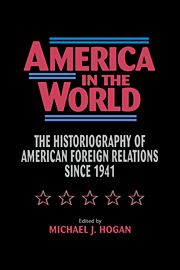
- America in the WorldThe Historiography of US Foreign Relations since 1941, pp. 358 - 394Publisher: Cambridge University PressPrint publication year: 1996
Accessibility standard: Unknown
Why this information is here
This section outlines the accessibility features of this content - including support for screen readers, full keyboard navigation and high-contrast display options. This may not be relevant for you.Accessibility Information
Accessibility compliance for the PDF of this chapter is currently unknown
and may be updated in the future.
- 2
- Cited by