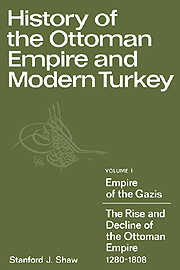
Book contents
- Frontmatter
- Contents
- Preface
- Abbreviations
- Note on Pronunciation
- Map of the Growth of the Ottoman Empire to 1683
- Part One Rise of the Ottoman Empire, 1280–1566
- Part Two Decentralization and Traditional Reform in Response to Challenge
- 6 Decentralization and Traditional Reform, 1566–1683
- 7 New Challenges and Responses, 1683–1808
- 8 Ottoman Society, Administration, and Culture in the Age of Decentralization and Traditionalistic Reform, 1566–1808
- Map of the Decline of the Ottoman Empire, 1683–1924
- Bibliography: Ottoman History to 1808
- Index
8 - Ottoman Society, Administration, and Culture in the Age of Decentralization and Traditionalistic Reform, 1566–1808
Published online by Cambridge University Press: 02 February 2010
Book contents
- Frontmatter
- Contents
- Preface
- Abbreviations
- Note on Pronunciation
- Map of the Growth of the Ottoman Empire to 1683
- Part One Rise of the Ottoman Empire, 1280–1566
- Part Two Decentralization and Traditional Reform in Response to Challenge
- 6 Decentralization and Traditional Reform, 1566–1683
- 7 New Challenges and Responses, 1683–1808
- 8 Ottoman Society, Administration, and Culture in the Age of Decentralization and Traditionalistic Reform, 1566–1808
- Map of the Decline of the Ottoman Empire, 1683–1924
- Bibliography: Ottoman History to 1808
- Index
Summary
Before looking into the process by which modern reform transformed the Ottoman system, we must first conclude our examination of the era of decentralization and traditionalistic reform with a study of the means by which society adjusted itself to the problems that the empire faced from the reign of Süleyman the Magnificent to the beginning of the nineteenth century.
Administration and Society
In spite of economic mismanagement, administrative inefficiency, political corruption, and policies based on group rather than state interest, state and society survived with much less disruption than one might imagine. How was this accomplished?
The process of adjustment was characterized at the center by an expansion in the numbers and functions of the corps of scribes (küttap), who extended their power to all branches of the Ruling Class, forming a permanent substructure of career bureaucrats who continued to administer the law and carry out the functions of administration almost oblivious to the shifts and starts as well as the incompetence and corruption of those nominally above them. Coordinating their operations and influence was the scribal guild itself, training, maintaining, providing, and commanding the scribes who carried out every function according to their own traditions and systems with only nominal reference to the officials supposedly directing them. Thus it was that the reis ul-küttap (chief of scribes) – officially only head of the Chancery of the Imperial Council beneath the orders of the grand vezir and equal to the chief treasurer and the ağas of the military corps – in fact exceeded them in power through his parallel position as leader of the scribal corporation.
Information
- Type
- Chapter
- Information
- History of the Ottoman Empire and Modern Turkey , pp. 280 - 299Publisher: Cambridge University PressPrint publication year: 1976
Accessibility standard: Unknown
Why this information is here
This section outlines the accessibility features of this content - including support for screen readers, full keyboard navigation and high-contrast display options. This may not be relevant for you.Accessibility Information
Accessibility compliance for the PDF of this chapter is currently unknown
and may be updated in the future.
- 1
- Cited by