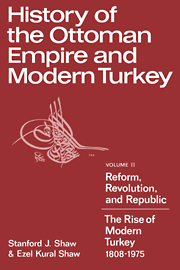
Book contents
- Frontmatter
- Contents
- List of Tables
- Preface
- Preface to the second printing
- List of Abbreviations
- Note on Pronunciation
- Map of the Growth of the Ottoman Empire, 1280–1683
- Map of the Decline of the Ottoman Empire, 1683–1975
- 1 The Beginnings of Modern Ottoman Reform: The Era of Mahmut II, 1808–1839
- 2 The Era of Modern Reform: The Tanzimat, 1839–1876
- 3 Culmination of the Tanzimat: The Reign of Abdulhamit II, 1876–1909
- 4 The Young Turk Period, 1908–1918
- 5 The Turkish War for Independence, 1918–1923
- 6 The Turkish Republic, 1923–1975
- Appendix
- Bibliography: History of the Ottoman Empire and Modern Turkey, 1808–1975
- Index
1 - The Beginnings of Modern Ottoman Reform: The Era of Mahmut II, 1808–1839
Published online by Cambridge University Press: 20 May 2010
Book contents
- Frontmatter
- Contents
- List of Tables
- Preface
- Preface to the second printing
- List of Abbreviations
- Note on Pronunciation
- Map of the Growth of the Ottoman Empire, 1280–1683
- Map of the Decline of the Ottoman Empire, 1683–1975
- 1 The Beginnings of Modern Ottoman Reform: The Era of Mahmut II, 1808–1839
- 2 The Era of Modern Reform: The Tanzimat, 1839–1876
- 3 Culmination of the Tanzimat: The Reign of Abdulhamit II, 1876–1909
- 4 The Young Turk Period, 1908–1918
- 5 The Turkish War for Independence, 1918–1923
- 6 The Turkish Republic, 1923–1975
- Appendix
- Bibliography: History of the Ottoman Empire and Modern Turkey, 1808–1975
- Index
Summary
On May 29, 1807, Sultan Selim III was deposed, the reformed Nizam-i Cedit army disbanded, and his effort to modernize the Ottoman Empire momentarily blocked. Reaction again prevailed within the Ottoman Ruling Class. During the short reign of his successor Mustafa IV (1807–1808), the Janissaries and their allies attempted to eliminate all those who had dared oppose the old order. Yet this did not happen. The supporters of Selim, those who had managed to survive, joined under the leadership of the Danubian notable Bayraktar Mustafa Paşa to rescue Selim and restore his reforms. Bayraktar brought his army to Istanbul, but before it could break into the palace, Selim was assassinated. To realize their goal Bayraktar Mustafa and his supporters placed on the throne Selim's cousin Mahmut II (1808–1839), who had shared Selim's palace imprisonment and was known to hold many of the same reforming ideas (July 28, 1808).
Mahmut in time emerged as a far stronger and much more successful reformer than Selim. But his was a very long reign, and it was only much later, in 1826, that he was able to destroy the Janissary corps, thus depriving the conservatives of their military arm and setting Ottoman reform on a new course of destroying old institutions and replacing them with new ones mainly imported from the West.
What made Mahmut II different from Selim III? They had been raised together. They had received the same traditional palace education spiced with occasional information about the outside world and had had little opportunity to gain the practical experience needed to transform their ideas into reality. But Mahmut witnessed the results of Selim's weakness and indecision.
Information
- Type
- Chapter
- Information
- History of the Ottoman Empire and Modern Turkey , pp. 1 - 54Publisher: Cambridge University PressPrint publication year: 1977
Accessibility standard: Unknown
Why this information is here
This section outlines the accessibility features of this content - including support for screen readers, full keyboard navigation and high-contrast display options. This may not be relevant for you.Accessibility Information
Accessibility compliance for the PDF of this chapter is currently unknown
and may be updated in the future.