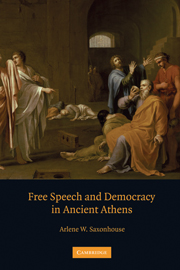
5 - The Trial of Socrates
Published online by Cambridge University Press: 06 January 2010

Summary
In the archonship of Laches (400/399) Anytus, Meletus, and Lycos brought a public indictment against Socrates. It read:
Swearing an oath Meletus the son of Meletus of Pitthos brought a public action against Socrates the son of Sophroniscus of Alopeke; he said Socrates was guilty of not believing in the gods that the city believed in, and that he brought into the city other new divinities. Further, he is guilty of corrupting the young. The punishment is death.
(Diogenes Laertius 2.40)Meletus as the main accuser was liable to a fine of 1,000 drachma if fewer than one fifth of the jurors found Socrates guilty. Thus began the trial of Socrates. It ended when the jurors voted 280 to 221 for a guilty verdict and when they followed with a vote for the penalty of death. Meletus did not have to pay any fine.
WHY WAS SOCRATES EXECUTED?
The trial of Socrates has served for many generations as a symbol of the violation of freedom of expression, the case that sets the individual committed to the “examined life” against a city that can find in this examination impiety and the corruption of the young. It is the incident that speaks to all who fear oppression for the expression of one's beliefs and thoughts. As J. S. Mill writes in On Liberty:
Mankind can hardly be too often reminded that there was once a man named Socrates, between whom and the legal authorities and public opinion of his time there took place a memorable collision. […]
Information
- Type
- Chapter
- Information
- Free Speech and Democracy in Ancient Athens , pp. 100 - 126Publisher: Cambridge University PressPrint publication year: 2005
Accessibility standard: Unknown
Why this information is here
This section outlines the accessibility features of this content - including support for screen readers, full keyboard navigation and high-contrast display options. This may not be relevant for you.Accessibility Information
Accessibility compliance for the PDF of this chapter is currently unknown
and may be updated in the future.