Book contents
- Frontmatter
- Contents
- List of Contributors
- Acknowledgments
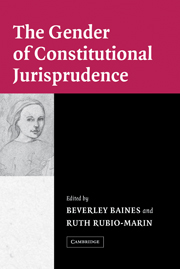
- The Gender of Constitutional Jurisprudence
- Introduction: Toward a Feminist Constitutional Agenda
- 1 Speaking into a Silence: Embedded Constitutionalism, the Australian Constitution, and the Rights of Women
- 2 Using the Canadian Charter of Rights and Freedoms to Constitute Women
- 3 Emancipatory Equality: Gender Jurisprudence under the Colombian Constitution
- 4 Gender Equality and International Human Rights in Costa Rican Constitutional Jurisprudence
- 5 Constituting Women: The French Ways
- 6 Gender in the German Constitution
- 7 India, Sex Equality, and Constitutional Law
- 8 Constitutional Transformation, Gender Equality, and Religious/National Conflict in Israel: Tentative Progress through the Obstacle Course
- 9 “No Nation Can Be Free When One Half of It Is Enslaved”: Constitutional Equality for Women in South Africa
- 10 Engendering the Constitution: The Spanish Experience
- 11 Gender Equality from a Constitutional Perspective: The Case of Turkey
- 12 Gender and the United States Constitution: Equal Protection, Privacy, and Federalism
- Index
- References
2 - Using the Canadian Charter of Rights and Freedoms to Constitute Women
Published online by Cambridge University Press: 14 January 2010

Book contents
- Frontmatter
- Contents
- List of Contributors
- Acknowledgments
- The Gender of Constitutional Jurisprudence
- Introduction: Toward a Feminist Constitutional Agenda
- 1 Speaking into a Silence: Embedded Constitutionalism, the Australian Constitution, and the Rights of Women
- 2 Using the Canadian Charter of Rights and Freedoms to Constitute Women
- 3 Emancipatory Equality: Gender Jurisprudence under the Colombian Constitution
- 4 Gender Equality and International Human Rights in Costa Rican Constitutional Jurisprudence
- 5 Constituting Women: The French Ways
- 6 Gender in the German Constitution
- 7 India, Sex Equality, and Constitutional Law
- 8 Constitutional Transformation, Gender Equality, and Religious/National Conflict in Israel: Tentative Progress through the Obstacle Course
- 9 “No Nation Can Be Free When One Half of It Is Enslaved”: Constitutional Equality for Women in South Africa
- 10 Engendering the Constitution: The Spanish Experience
- 11 Gender Equality from a Constitutional Perspective: The Case of Turkey
- 12 Gender and the United States Constitution: Equal Protection, Privacy, and Federalism
- Index
- References

HTML view is not available for this content. However, as you have access to this content, a full PDF is available via the 'Save PDF' action button.
Summary
In 1867, Britain gave its Canadian colonies a written Constitution that imposed a federal system of parliamentary government. While making jurisdiction a constraint on law-making, this Constitution did not provide Canadians with human rights protections (although rights such as freedom of contract and private property received common law protection). The legislatures could pass laws denying women the right to vote, hold public office, serve on juries or in the armed forces, immigrate, perform certain jobs, have an independent domicile or continue to work after marriage, dispose of property, have an abortion, receive unemployment insurance after giving birth, retain aboriginal status on marrying a non-aboriginal, or retain Canadian citizenship on marrying a non-Canadian. Whenever litigants challenged these laws by invoking international, statutory, or unwritten human rights protections, most Canadian judges refused to recognize their claims. Thus, constitutional litigation was not a viable strategy for women.
This picture changed significantly when the existing Constitution was supplemented by new constitutional provisions in 1982. Prominent among these changes was the Charter, which delineates seven major rights: political (religion, expression, assembly, and association), democratic, mobility, legal, equality, language (official and minority educational), and aboriginal rights. Canadians may assert Charter rights against both levels of government, albeit not against private actors unless they are carrying out a governmental function. This rights protection regime transformed the system of government from parliamentary to constitutional supremacy by assigning the enforcement of Charter rights to the regular courts.
Information
- Type
- Chapter
- Information
- The Gender of Constitutional Jurisprudence , pp. 48 - 74Publisher: Cambridge University PressPrint publication year: 2004
References
Ellen Anderson, Judging Bertha Wilson: Law as Large as Life (Toronto: University of Toronto Press, 2001)
Anne F. Bayefsky and Mary Eberts, eds., Equality Rights and the Canadian Charter of Rights and Freedoms (Toronto: Carswell, 1985)
Susan B. Boyd, Child Custody, Law, and Women's Work (Don Mills, ON: Oxford University Press Canada, 2003)
Canadian Journal of Women and the Law (1985) Volume I and following
, “Symes v. M.N.R.: Where Sex Meets Class” (1992) 5 Canadian Journal of Women and the Law498Google Scholar
, “Accountability of Public Authorities, Sex Discrimination and the Public/Private Divide in Tort Law: An Analysis of Doe v. Metropolitan Toronto (Municipality) Commissioners of Police” (2001) 26 Queen's Law Journal451Google Scholar
Julian V. Roberts and Renate M. Mohr, eds., Confronting Sexual Assault: A Decade of Legal and Social Change (Toronto: University of Toronto Press, 1994)
Lynn Smith and Eleanor Wachtel, A Feminist Guide to the Canadian Constitution (Ottawa: Canadian Advisory Council on the Status of Women, 1992)
Accessibility standard: Unknown
Why this information is here
This section outlines the accessibility features of this content - including support for screen readers, full keyboard navigation and high-contrast display options. This may not be relevant for you.Accessibility Information
Accessibility compliance for the PDF of this chapter is currently unknown
and may be updated in the future.
 You have
Access
You have
Access
- 2
- Cited by