Book contents
- Frontmatter
- Contents
- Preface
- Table of cases
- Table of legislative provisions
- List of abbreviations
- PART I Establishment of the tribunals
- PART II Jurisdiction
- PART III Substantive and procedural aspects of prosecution
- 9 General principles of law
- 10 Investigation and pre-trial procedure
- 11 Trial and post-trial procedure
- 12 Evidence
- 13 Rights of the accused
- 14 Punishment
- PART IV Organisation of the tribunals
- Bibliography
- Index
13 - Rights of the accused
Published online by Cambridge University Press: 05 June 2012

Book contents
- Frontmatter
- Contents
- Preface
- Table of cases
- Table of legislative provisions
- List of abbreviations
- PART I Establishment of the tribunals
- PART II Jurisdiction
- PART III Substantive and procedural aspects of prosecution
- 9 General principles of law
- 10 Investigation and pre-trial procedure
- 11 Trial and post-trial procedure
- 12 Evidence
- 13 Rights of the accused
- 14 Punishment
- PART IV Organisation of the tribunals
- Bibliography
- Index
Summary
During the Second World War, Churchill, Roosevelt and Stalin all entertained – it is difficult to determine how seriously – the idea of some form of summary justice for major war criminals. The concept now is unthinkable. Indeed, only a few years later, one of the Nuremberg tribunals held that prosecutors and judges involved in a trial lacking the fundamental guarantees of fairness could be held responsible for crimes against humanity. Such guarantees include the right of the accused to introduce evidence, to confront witnesses, to present evidence, to be tried in public, to have counsel of choice, and to be informed of the nature of the charges. Common article 3 of the Geneva Conventions, adopted in 1949, refers to ‘the judicial guarantees which are recognized as indispensable by civilized peoples’ and prohibits ‘the passing of sentences and the carrying out of executions without previous judgment pronounced by a regularly constituted court, affording all the judicial guarantees which are recognized as indispensable by civilized peoples’.
‘It is axiomatic that the International Tribunal must fully respect internationally recognised standards regarding the rights of the accused at all stages of its proceedings’, said the Secretary-General in his report to the Security Council accompanying the draft ICTY Statute. The Secretary-General cited article 14 of the International Covenant on Civil and Political Rights, the gold standard in terms of codification of the right to a fair trial in international human rights law.
Information
- Type
- Chapter
- Information
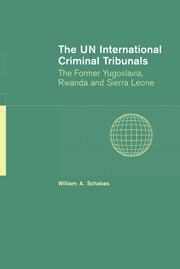
- The UN International Criminal TribunalsThe Former Yugoslavia, Rwanda and Sierra Leone, pp. 501 - 544Publisher: Cambridge University PressPrint publication year: 2006
Accessibility standard: Unknown
Why this information is here
This section outlines the accessibility features of this content - including support for screen readers, full keyboard navigation and high-contrast display options. This may not be relevant for you.Accessibility Information
Accessibility compliance for the PDF of this chapter is currently unknown
and may be updated in the future.