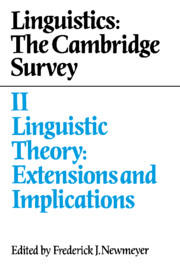
Book contents
- Frontmatter
- Contents
- Contributors
- Preface
- 1 Extensions and implications of linguistic theory: an overview
- 2 Grammar and language processing
- 3 Grammatical principles of first language acquisition: theory and evidence
- 4 Second language acquisition and grammatical theory
- 5 Brain structures and linguistic capacity
- 6 Abnormal language acquisition and the modularity of language
- 7 Grammatical aspects of speech errors
- 8 Grammar and conversational principles
- 9 Discourse analysis: a part of the study of linguistic competence
- 10 Speech act distinctions in grammar
- 11 Computer applications of linguistic theory
- 12 Metrics and phonological theory
- 13 Grammatical theory and signed languages
- 14 The linguistic status of creole languages: two perspectives
- 14.I Creole languages and the bioprogram
- 14.II Are creoles a special type of language?
- 14.III A dialog concerning the linguistic status of creole languages
- Subject index
- Name index
- Contents of volumes I, III, and IV
14.I - Creole languages and the bioprogram
Published online by Cambridge University Press: 08 February 2010
Edited by
Book contents
- Frontmatter
- Contents
- Contributors
- Preface
- 1 Extensions and implications of linguistic theory: an overview
- 2 Grammar and language processing
- 3 Grammatical principles of first language acquisition: theory and evidence
- 4 Second language acquisition and grammatical theory
- 5 Brain structures and linguistic capacity
- 6 Abnormal language acquisition and the modularity of language
- 7 Grammatical aspects of speech errors
- 8 Grammar and conversational principles
- 9 Discourse analysis: a part of the study of linguistic competence
- 10 Speech act distinctions in grammar
- 11 Computer applications of linguistic theory
- 12 Metrics and phonological theory
- 13 Grammatical theory and signed languages
- 14 The linguistic status of creole languages: two perspectives
- 14.I Creole languages and the bioprogram
- 14.II Are creoles a special type of language?
- 14.III A dialog concerning the linguistic status of creole languages
- Subject index
- Name index
- Contents of volumes I, III, and IV
Summary
The historical context of Creole languages
There are two ways in which new languages may arise: one gradual, one catastrophic. The former, probably the better known of the two, involves the progressive divergence of related dialects, a process which most frequently arises when two or more populations of speakers become isolated from one another. Such situations came about, for example, with dialects of Latin after the collapse of the Roman Empire, and with dialects of Polynesian after the diaspora that populated the islands of the Eastern and Southern Pacific. After a number of centuries, processes of lexical and morphological change and decay and the emergence of syntactic and phonological innovations may render such dialects mutually unintelligible; these processes may, of course, be intensified and speeded up by language contact with unrelated groups. At some hard-to-determine point, we may conclude that the dialects are dialects no longer, but distinct languages.
In the present chapter I shall have nothing to say about language formation of this kind, which appears to obey no particular laws and to be largely at the mercy of historical accident. Instead, I shall concentrate on the catastrophic way, one in which new languages are produced ab ovo within the space of, at most, one or two generations. This process is of interest not merely in its own right, but for the light that it can shed on the nature of language in general.
Information
- Type
- Chapter
- Information
- Linguistics: The Cambridge Survey , pp. 268 - 284Publisher: Cambridge University PressPrint publication year: 1988
Accessibility standard: Unknown
Why this information is here
This section outlines the accessibility features of this content - including support for screen readers, full keyboard navigation and high-contrast display options. This may not be relevant for you.Accessibility Information
Accessibility compliance for the PDF of this chapter is currently unknown
and may be updated in the future.
- 52
- Cited by