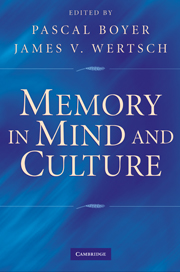
Book contents
- Frontmatter
- Contents
- List of Contributors
- PART I IN MIND, CULTURE, AND HISTORY: A SPECIAL PERSPECTIVE
- PART II HOW DO MEMORIES CONSTRUCT OUR PAST?
- PART III HOW DO WE BUILD SHARED COLLECTIVE MEMORIES?
- 5 Collective Memory
- 6 The Role of Repeated Retrieval in Shaping Collective Memory
- 7 Making History: Social and Psychological Processes Underlying Collective Memory
- 8 How Does Collective Memory Create a Sense of the Collective?
- PART IV HOW DOES MEMORY SHAPE HISTORY?
- PART V HOW DOES MEMORY SHAPE CULTURE?
- Index
- References
5 - Collective Memory
Published online by Cambridge University Press: 05 June 2012

Book contents
- Frontmatter
- Contents
- List of Contributors
- PART I IN MIND, CULTURE, AND HISTORY: A SPECIAL PERSPECTIVE
- PART II HOW DO MEMORIES CONSTRUCT OUR PAST?
- PART III HOW DO WE BUILD SHARED COLLECTIVE MEMORIES?
- 5 Collective Memory
- 6 The Role of Repeated Retrieval in Shaping Collective Memory
- 7 Making History: Social and Psychological Processes Underlying Collective Memory
- 8 How Does Collective Memory Create a Sense of the Collective?
- PART IV HOW DOES MEMORY SHAPE HISTORY?
- PART V HOW DOES MEMORY SHAPE CULTURE?
- Index
- References
Summary
“Collective memory” is a term that appears frequently in the media and everyday conversation. We use it when talking about the causes of ethnic violence and geopolitical miscalculation, political leaders invoke it in times of crisis, and it is behind massive expenditures on museums and holidays. In general, it is hard to go more than a few days without encountering the notion somewhere, but when we try to say just what collective memory is, we realize how little we understand about its workings.
Despite – or perhaps because of – this conceptual muddle, a renewed “memory industry” (Klein, 2000) has sprung up over the past two decades. The open-ended nature of this enterprise is reflected in the plethora of terms that can be found in writings on the topic, terms such as “public memory” (Bodnar, 1992), “social memory” (Burke, 1989; Connerton, 1989), “cultural memory” (Berliner, 2005), “bodily memory” (Young, 1996), “historical consciousness” (Seixas, 2004), and “mnemonic battles” (Zerubavel, 2003).
Part of the difficulty in bringing together all these strands of inquiry stems from the number of disciplines involves. The list includes anthropology (Berliner, 2005; Cole, 2001), history (Novick, 1999), psychology (Pennebaker, Paez, & Rimé, 1997), and sociology (e.g., Schuman, Schwartz, & D'Arcy, 2005). Further complications arise from the fact that collective memory can be at the center of debates – often quite heated – in the public arena and popular media where little attention is given to clear definitions.
Information
- Type
- Chapter
- Information
- Memory in Mind and Culture , pp. 117 - 137Publisher: Cambridge University PressPrint publication year: 2009
References
(1995). Remembering: A study in experimental and social psychology. Cambridge: Cambridge University Press. (first published in 1932).CrossRefGoogle Scholar
, & (1991). Connectionism and the mind: An introduction to parallel processing in networks. Oxford: Blackwell.Google Scholar
, & (2002). Emotionally charged autobiographical memories across the life span: The recall of happy, sad, traumatic, and involuntary memories. Psychology and Aging, 17, 636–652.CrossRefGoogle ScholarPubMed
(1992). Remaking America: Public memory, commemoration, and patriotism in the twentieth century. Princeton: Princeton University Press.Google Scholar
(1989). History as social memory. In (Ed.), Memory: History, culture and the mind (pp. 97–113). Oxford: Basil Blackwell.Google Scholar
(2001). Forget colonialism? Sacrifice and the art of memory in Madagascar. Berkeley: University of California Press.Google Scholar
(1997). The inventory of experience: Memory and identity. In , , & (Eds.), Collective memory of political events: Social psychological perspectives (pp. 21–45). Mahwah, NJ: Lawrence Erlbaum Associates.Google Scholar
, & (2000). The construction of autobiographical memories in the self-memory system. Psychological Review, 107(2), 261–288.CrossRefGoogle ScholarPubMed
(1980). Introduction: Maurice Halbwachs (1877–1945). In (Eds.), The collective memory. New York: Harper & Row. (Trans by . & ).Google Scholar
(1996). Three narratives of our humanity. In & (Eds.), History wars: The Enola Gay and other battles for America's past (pp. 63–96). New York: Metropolitan Books.Google Scholar
(1988). Vivid memories and the reminiscence phenomenon: The role of a self narrative. Human Development, 31, 261–273.CrossRefGoogle Scholar
(1995). Intersecting meanings of reminiscence in adult development and aging. In (Ed.), Remembering our past: Studies in autobiographical memory (pp. 360–383). Cambridge: Cambridge University Press.Google Scholar
(1996). Memory sciences, memory politics. In & (Eds.), Tense past: Cultural essays in trauma and memory (pp. 67–87). New York: Routledge.Google Scholar
(1992). On collective memory. Chicago: University of Chicago Press. (Ed. and Trans. by ).Google Scholar
(2000). On the emergence of memory in historical discourse. Representations, 69, 127–150.CrossRefGoogle Scholar
(1981). The problem of activity in psychology. In (Ed.), The concept of activity in Soviet psychology (pp. 37–71). Armonk, NY: M.E. Sharpe.Google Scholar
(1996). Anatomy of a controversy. In & (Eds.), History wars: The Enola Gay and other battles for America's past (pp. 9–62). New York: Metropolitan Books.Google Scholar
, & (Eds.) (1996). History wars: The Enola Gay and other battles for America's past. New York: Metropolitan Books.
, & (1985). Binary models in the dynamics of Russian culture (to the end of the eighteenth century). In & (Eds.), The semiotics of Russian cultural history. Essays by Iurii M. Lotman, Lidiia Ia. Ginsburg, Boris A. Uspenskii (pp. 30–66). Ithaca: Cornell University Press.Google Scholar
(1994). Identity, heritage, and history. In (Ed.), Commemorations: The politics of national identity (pp. 41–57). Princeton: Princeton University Press.Google Scholar
(1977). Methodological individualism reconsidered. In (Ed.), Essays in social theory (pp. 177–186). New York: Columbia University Press.CrossRefGoogle Scholar
(1984). After virtue: A study in moral theory. Notre Dame, Indiana: University of Notre Dame Press.Google Scholar
(1952). The problem of generations. Chapter VII in: K. Mannheim. Essays on the sociology of knowledge (pp. 276–320). London: Routledge & Kegan Paul Ltd. (Ed. by ).Google Scholar
, & (1990). Conversational remembering: A social psychological approach. In & (Eds.), Collective remembering (pp. 23–45). London: Sage Publications.Google Scholar
(1978). Narrative form as a cognitive instrument. In R. H. Canary & (Eds.), The writing of history: Literary form and historical understanding (pp. 129–149). Madison: University of Wisconsin Press.Google Scholar
(1989). Between memory and history: Les lieux de mémoire. Representations, 26, 7–25.CrossRefGoogle Scholar
, , & (Eds.). (1997). Collective memory of political events: Social psychological perspectives. Mahwah, NJ: Lawrence Erlbaum Associates Publishers.
(1968). Morphology of the folktale. Austin, TX: University of Texas Press. (Trans. by ).Google Scholar
, & (1995). Creating false memories: Remembering words not presented in lists. Journal of Experimental Psychology: Learning, Memory, and Cognition, 21, 803–814.Google Scholar
(1989). Relation of implicit theories to the construction of personal histories. Psychological Review, 96(2) 341–357.CrossRefGoogle Scholar
, , & (1986). Autobiographical memory across the adult lifespan. In (Ed.), Autobiographical memory (pp. 202–221). New York: Cambridge University Press.CrossRefGoogle Scholar
(1996). Searching for memory: The brain, the mind, and the past. New York: Basic Books.Google Scholar
, , & . (2005). Elite revisionists and popular beliefs: Christopher Columbus, hero or villain?Public Opinion Quarterly, 69(1), 2–29.CrossRefGoogle Scholar
, & . (1989). Generations and collective memories. American Sociological Review, 4 (54), 359–381.CrossRefGoogle Scholar
(Ed.). (2004). Theorizing historical consciousness. Toronto: University of Toronto Press.
(1990). Listening for the text: On the uses of the past. Philadelphia: University of Pennsylvania Press.Google Scholar
(1981). The instrumental method in psychology. In (Ed.), The concept of activity in Soviet psychology (pp. 134–143). Armonk, NY: M.E. Sharpe.Google Scholar
(2001). Remembering as a social process. In (Ed.), The psychology of learning and motivation (pp. 67–120). San Diego: Academic Press.Google Scholar
, & (1994). Multivoicedness in historical representation: American college students' accounts of the origins of the U.S. Journal of Narrative and Life History, 4(4), 295–310.Google Scholar
(2002). Voices of collective remembering. New York: Cambridge University Press.CrossRefGoogle Scholar
(2008a). Blank spots in collective memory: A case study of Russia. The Annals of the American Academy of Political and Social Science, 617 (May), 58–71.CrossRefGoogle Scholar
(2008b). A clash of deep memories. Profession 2008. New York: Modern Language Association, 2008, pp. 46–53.Google Scholar
(1987). The content of the form: Narrative discourse and historical representation. Baltimore: The Johns Hopkins University Press.Google Scholar
(1996). Bodily memory and traumatic memory. In & (Eds.), Tense past: Cultural essays in trauma and memory (pp. 89–102). New York: Routledge.Google Scholar
Accessibility standard: Unknown
Why this information is here
This section outlines the accessibility features of this content - including support for screen readers, full keyboard navigation and high-contrast display options. This may not be relevant for you.Accessibility Information
Accessibility compliance for the PDF of this chapter is currently unknown
and may be updated in the future.
- 85
- Cited by