Book contents
- Frontmatter
- Contents
- List of illustrations
- List of contributors
- Introduction
- PART I THE PRE-MODERN WORLD
- PART II TRANSITIONS TO THE MODERN WORLD
- PART III MODERNITY AND ITS DISCONTENTS
- 8 Science, politics, enchantment
- 9 Deconstructing post-modernism: Gellner and Crocodile Dundee
- 10 A methodology without presuppositions?
- 11 Gellner's positivism
- 12 Left versus Right in French political ideology
- 13 Property, justice and common good after socialism
- 14 Social contract, democracy and freedom
- 15 Thoughts on liberalisation
- 16 Peace, peace at last?
- Indexes
16 - Peace, peace at last?
Published online by Cambridge University Press: 02 February 2010
By

Book contents
- Frontmatter
- Contents
- List of illustrations
- List of contributors
- Introduction
- PART I THE PRE-MODERN WORLD
- PART II TRANSITIONS TO THE MODERN WORLD
- PART III MODERNITY AND ITS DISCONTENTS
- 8 Science, politics, enchantment
- 9 Deconstructing post-modernism: Gellner and Crocodile Dundee
- 10 A methodology without presuppositions?
- 11 Gellner's positivism
- 12 Left versus Right in French political ideology
- 13 Property, justice and common good after socialism
- 14 Social contract, democracy and freedom
- 15 Thoughts on liberalisation
- 16 Peace, peace at last?
- Indexes
Summary
If the extraordinary range of Ernest Gellner's writings over the last two decades makes it clear that his intellectual project is nothing less than that of characterising the spirit of modernity, his most striking statement about the principles of social organisation suited to the modern era remains that offered in Thought and Change. Legitimacy in the modern world, he asserted, does depend and ought to depend upon obeisance to two, and only two, principles: nationalism and industrialism. On reflection, the latter of these two principles should be considered the more important for Gellner, given his insistence on explaining nationalism as a corollary of industrialism – or, more precisely, as an unintended consequence of the uneven diffusion of industrialism around the globe. Although a consideration of the prospects of peace requires some consideration of nationalism, the privileged position Gellner lends to industrialism in his thought is taken as justification for a similar concentration in this essay. My intention here is to flesh out one aspect of the industrial society thesis, namely its attitude towards geopolitical conflict. In summary terms, the industrial society theorists expected that their new world would bring peace. Gellner puts the matter like this:
On any moderately realistic estimate of human nature, as long as the price of decent behaviour was, in effect, total self-sacrifice (which was the case in the conditions of scarcity which characterised preindustrial society), the prospects of decent behaviour were negligible. But thanks to the cognitive and technical effectiveness of industrial society, the possibility, though no more, is now present.
Information
- Type
- Chapter
- Information
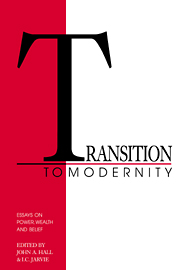
- Transition to ModernityEssays on Power, Wealth and Belief, pp. 343 - 367Publisher: Cambridge University PressPrint publication year: 1992
Accessibility standard: Unknown
Why this information is here
This section outlines the accessibility features of this content - including support for screen readers, full keyboard navigation and high-contrast display options. This may not be relevant for you.Accessibility Information
Accessibility compliance for the PDF of this chapter is currently unknown
and may be updated in the future.