Book contents
- Frontmatter
- Contents
- Acknowledgments
- List of abbreviations
- 1 Introduction: gene transfer lost in translation
- 2 What is gene transfer?
- 3 Safety, values, and legitimacy: the protean nature of risk in translational trials
- 4 Taming uncertainty: risk and gene-transfer clinical research
- 5 Succor or suckers? Benefit, risk, and the therapeutic misconception
- 6 Looking backward: a model of value for translational trials
- 7 The chasm: the ethics of initiating first-in-human clinical trials
- 8 Tropic of cancers: gene transfer in resource-poor settings
- 9 Great Expectations and Hard Times: expectation management in gene transfer
- 10 Something in the sight adjusts itself: conclusions
- Epilogue
- Index
4 - Taming uncertainty: risk and gene-transfer clinical research
Published online by Cambridge University Press: 28 January 2010

Book contents
- Frontmatter
- Contents
- Acknowledgments
- List of abbreviations
- 1 Introduction: gene transfer lost in translation
- 2 What is gene transfer?
- 3 Safety, values, and legitimacy: the protean nature of risk in translational trials
- 4 Taming uncertainty: risk and gene-transfer clinical research
- 5 Succor or suckers? Benefit, risk, and the therapeutic misconception
- 6 Looking backward: a model of value for translational trials
- 7 The chasm: the ethics of initiating first-in-human clinical trials
- 8 Tropic of cancers: gene transfer in resource-poor settings
- 9 Great Expectations and Hard Times: expectation management in gene transfer
- 10 Something in the sight adjusts itself: conclusions
- Epilogue
- Index
Summary
One clear bag of fluid
In September 2001, one-year-old Rhys Evans became the poster child for gene transfer. The Welsh boy had been diagnosed with X-linked Severe Combined Immune Deficiency (X-SCID) after months of infections, oxygen tents, intensive care, and finally, an isolation room. His parents – one a teacher, the other a pipe fitter – were offered two options by his caregivers at the Great Ormond Street Hospital in London: bone-marrow transplantation plus a brutal regime of chemotherapy (to allow the new tissue to “take”), or an experimental procedure – gene transfer – that had shown success in two infants at Paris's Necker Hospital. Fearing the potentially lethal consequences of chemotherapy, the parents elected for gene transfer, and in July Evans received what his mother recorded in her diary as “one clear bag of fluid.”.Within weeks, immunological parameters began normalizing, and as Rhys approached his second birthday he was discharged from the hospital. Today, Evans leads a normal life – aside from occasional public appearances for charity, and lots of medical monitoring.
The latter has proven especially important in Evans's case because, across the English Channel, several of his X-SCID peers who underwent the same procedure were not as fortunate. Under the leadership of immunologists Alain Fischer and Marina Cavazzana-Calvo, several children had been cured in a protocol initiated in 1998. But by the early summer of 2002, the French team detected a never-before observed lymphoproliferative disorder in one of their patients. By December, a second patient began showing identical indications. Two years later, a third patient developed the disorder.
Information
- Type
- Chapter
- Information
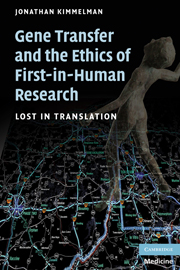
- Gene Transfer and the Ethics of First-in-Human ResearchLost in Translation, pp. 51 - 71Publisher: Cambridge University PressPrint publication year: 2009
Accessibility standard: Unknown
Why this information is here
This section outlines the accessibility features of this content - including support for screen readers, full keyboard navigation and high-contrast display options. This may not be relevant for you.Accessibility Information
Accessibility compliance for the PDF of this chapter is currently unknown
and may be updated in the future.