Preface and acknowledgements
Published online by Cambridge University Press: 09 March 2010

Summary
This book results from a conference held to celebrate the seventy-fifth anniversary of the world's first department of international politics. We wanted to celebrate the institutional birth of a separate discipline by examining an issue that relates not only to all aspects of the discipline but also brings to centre-stage the meta-theoretical positions within the subject. After all, it was precisely a concern with the importance of ideas that led David Davies to set up the Woodrow Wilson Chair of International Politics at Aberystwyth in 1919. The holder of that chair was expected to travel the world to spread the message that war was not some inevitable feature of the international body politic, but, rather, was something that could gradually be eradicated by knowledge working on practice. In this sense, today's central theoretical debate, which concerns the strengths and weaknesses of an international theory based on positivist assumptions, mirrors the origins of the discipline.
The main intellectual concern of the book, reflected in its subtitle, is to examine the state of international theory in the wake of a set of major attacks on its positivist traditions. Note that this subtitle does not claim that positivism is dead in international theory, only that there is now a much clearer notion of its alternatives. But the centrality of the debate between positivism and its alternatives is one that dominates the entire discipline, and it was this which led us to focus on this issue rather than any other for such an important anniversary.
Information
- Type
- Chapter
- Information
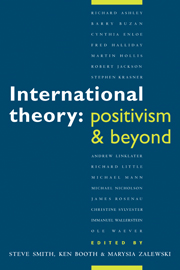
- International TheoryPositivism and Beyond, pp. xi - xivPublisher: Cambridge University PressPrint publication year: 1996
Accessibility standard: Unknown
Why this information is here
This section outlines the accessibility features of this content - including support for screen readers, full keyboard navigation and high-contrast display options. This may not be relevant for you.Accessibility Information
Accessibility compliance for the PDF of this chapter is currently unknown
and may be updated in the future.