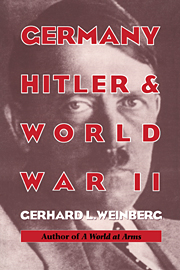
Book contents
- Frontmatter
- Contents
- Preface
- Introduction
- Part I Background
- Part II The Nazi system
- Part III Background for war
- Part IV World War II
- 12 German diplomacy toward the Soviet Union
- 13 The Nazi–Soviet pacts of 1939: A half century later
- 14 From confrontation to cooperation: Germany and the United States, 1917–1949
- 15 Pearl Harbor: The German perspective
- 16 Global conflict: The interaction between the European and Pacific theaters of war in World War II
- 17 The “Final Solution” and the war in 1943
- 18 July 20, 1944: The German resistance to Hitler
- 19 D-Day after fifty years: Assessments of costs and benefits
- 20 German plans for victory, 1944–1945
- 21 Reflections on running a war: Hitler, Churchill, Stalin, Roosevelt, Tojo
- 22 Some thoughts on World War II
- 23 A new Germany in a new world
- Appendix: the end of Ranke's history? Reflections on the fate of history in the twentieth century
- Index
19 - D-Day after fifty years: Assessments of costs and benefits
Published online by Cambridge University Press: 05 August 2012

Book contents
- Frontmatter
- Contents
- Preface
- Introduction
- Part I Background
- Part II The Nazi system
- Part III Background for war
- Part IV World War II
- 12 German diplomacy toward the Soviet Union
- 13 The Nazi–Soviet pacts of 1939: A half century later
- 14 From confrontation to cooperation: Germany and the United States, 1917–1949
- 15 Pearl Harbor: The German perspective
- 16 Global conflict: The interaction between the European and Pacific theaters of war in World War II
- 17 The “Final Solution” and the war in 1943
- 18 July 20, 1944: The German resistance to Hitler
- 19 D-Day after fifty years: Assessments of costs and benefits
- 20 German plans for victory, 1944–1945
- 21 Reflections on running a war: Hitler, Churchill, Stalin, Roosevelt, Tojo
- 22 Some thoughts on World War II
- 23 A new Germany in a new world
- Appendix: the end of Ranke's history? Reflections on the fate of history in the twentieth century
- Index
Summary
When we look back on the events of D-Day and the campaign which followed, a number of images immediately appear before our eyes, even if no pictures are projected onto a screen. We see the vast fleets approaching the shore, men scrambling into the water from landing craft as the gates open or the ramps are lowered, parachutists jumping into the unknown, defensive fire – at first sporadic, then picking up – long siegelike warfare reminiscent of the trenches of World War I, Cherbourg surrendering and Caen obliterated, more and more French communities shattered by bombs and artillery, the carnage of the German forces trying to escape the Falaise pocket, the dash across France, the liberation of Paris, the failure of Market-Garden and the grinding campaign of the late fall, the German Ardennes offensive and death in the snow, the bridge at Remagen, the rush into Germany, the ruined towns of Germany with white – or more likely gray – sheets hanging out of the windows, ghastly scenes in the camps as Allied troops enter as liberators, the endless miles of German soldiers trudging to POW camps on one side of the road as Allied tanks and trucks roll forward on the other.
In these mental images, we glimpse some indications of the costs: death at Omaha Beach and parachutists hanging in the trees, destroyed towns and the gaunt looks of men too long under fire, crashed gliders and a storm-wrecked Mulberry harbor. And if we visit the battlefields today, we see much reconstruction from the physical damage of war, but not too far away the rows of crosses and stars of David in the cemeteries.
Information
- Type
- Chapter
- Information
- Germany, Hitler, and World War IIEssays in Modern German and World History, pp. 254 - 273Publisher: Cambridge University PressPrint publication year: 1995
Accessibility standard: Unknown
Why this information is here
This section outlines the accessibility features of this content - including support for screen readers, full keyboard navigation and high-contrast display options. This may not be relevant for you.Accessibility Information
Accessibility compliance for the PDF of this chapter is currently unknown
and may be updated in the future.