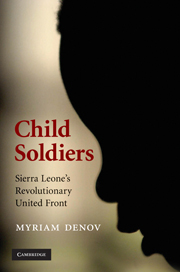
Book contents
- Frontmatter
- Contents
- Acknowledgements
- Map
- Introduction: Child soldiers, iconography and the (il)logic of extremes
- 1 Children's involvement in war: The quandary of structure and agency
- 2 Recipe for rebellion: Civil war in Sierra Leone
- 3 Negotiating power: Research on and by child soldiers
- 4 ‘Becoming RUF’: The making of a child soldier
- 5 ‘Being RUF’: Victimization, participation and resistance
- 6 ‘Put dey gon don’: The unmaking of a child soldier
- 7 New battlefields
- References
- Index
Introduction: Child soldiers, iconography and the (il)logic of extremes
Published online by Cambridge University Press: 04 May 2010

Book contents
- Frontmatter
- Contents
- Acknowledgements
- Map
- Introduction: Child soldiers, iconography and the (il)logic of extremes
- 1 Children's involvement in war: The quandary of structure and agency
- 2 Recipe for rebellion: Civil war in Sierra Leone
- 3 Negotiating power: Research on and by child soldiers
- 4 ‘Becoming RUF’: The making of a child soldier
- 5 ‘Being RUF’: Victimization, participation and resistance
- 6 ‘Put dey gon don’: The unmaking of a child soldier
- 7 New battlefields
- References
- Index
Summary
Over the past decade, images of child soldiers have inundated the popular media. Whether adorning the pages of popular magazines or newspapers, or flashing briefly before us in the form of video clips and news reports, images of boys armed with AK-47s appear ubiquitous, providing a cautionary tale not only of the reality of innocent childhood gone awry, but also of children as profoundly vulnerable, dangerous, victimized, disturbed and sometimes heroic. These images turn commonly held assumptions of protected and innocuous childhood on its head. They may simultaneously evoke collective shock, fear, revulsion, intrigue, pride, horror and sympathy. Such imagery harnesses our attention and compels us to look and perhaps read on momentarily. However, as captivating as these images are, what they obscure and conceal is equally illuminating. We, of course, learn little about the child behind the gun – how he (‘he’ because rarely are girls portrayed or included in such images) came to pose menacingly with a weapon – the gun essentially defining him. Moreover, we have no sense of what might have happened to the child in the years since the image was captured. What happened to the boy? Did he, as many would predict, grow up to be part of a terrorist organization? A mercenary? A warlord? Did he, seemingly against conventional wisdom and great odds, manage to overcome his violent past and embrace a ‘civilian’ identity? What about the many war-affected girls who are notably absent from such media depictions? What became of them?
Information
- Type
- Chapter
- Information
- Child SoldiersSierra Leone's Revolutionary United Front, pp. 1 - 19Publisher: Cambridge University PressPrint publication year: 2010
Accessibility standard: Unknown
Why this information is here
This section outlines the accessibility features of this content - including support for screen readers, full keyboard navigation and high-contrast display options. This may not be relevant for you.Accessibility Information
Accessibility compliance for the PDF of this chapter is currently unknown
and may be updated in the future.