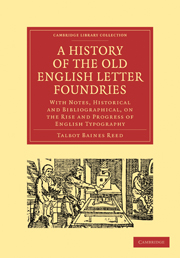
 A History of the Old English Letter Foundries
 With Notes, Historical and Bibliographical, on the Rise and Progress of English Typography
Book contents
- Frontmatter
- PREFACE
- Contents
- LIST OF ILLUSTRATIONS
- Introductory Chapter: THE TYPES AND TYPE FOUNDING OF THE FIRST PRINTERS
- Chap. 1 THE ENGLISH TYPE BODIES AND FACES
- Chap. 2 THE LEARNED, FOREIGN AND PECULIAR CHARACTERS
- Chap. 3 THE PRINTER LETTER-FOUNDERS, FROM CAXTON TO DAY
- Chap. 4 LETTER FOUNDING AS AN ENGLISH MECHANICAL TRADE
- Chap. 5 THE STATE CONTROL OF ENGLISH LETTER FOUNDING
- Chap. 6 THE OXFORD UNIVERSITY FOUNDRY
- Chap. 7 THE STAR CHAMBER FOUNDERS, AND THE LONDON POLYGLOT
- Chap. 8 JOSEPH MOXON
- Chap. 9 THE LATER FOUNDERS OF THE 17TH CENTURY
- Chap. 10 THOMAS AND JOHN JAMES
- Chap. 11 WILLIAM CASLON
- Chap. 12 ALEXANDER WILSON
- Chap. 13 JOHN BASKERVILLE
- Chap. 14 THOMAS COTTRELL
- Chap. 15 JOSEPH AND EDMUND FRY
- Chap. 16 JOSEPH JACKSON
- Chap. 17 WILLIAM MARTIN
- Chap. 18 VINCENT FIGGINS
- Chap. 19 THE MINOR FOUNDERS OF THE 18TH CENTURY
- Chap. 20 WILLIAM MILLER
- Chap. 21 THE MINOR FOUNDERS FROM 1800 TO 1830
- CHRONOLOGICAL TABLE OF ENGLISH LETTER-FOUNDERS' SPECIMENS NOTED IN THIS WORK 1665–1830
- LIST OF THE PRINCIPAL AUTHORITIES CONSULTED OR REFERRED TO
- INDEX
- Plate section
Chap. 1 - THE ENGLISH TYPE BODIES AND FACES
Published online by Cambridge University Press: 05 August 2011
Book contents
- Frontmatter
- PREFACE
- Contents
- LIST OF ILLUSTRATIONS
- Introductory Chapter: THE TYPES AND TYPE FOUNDING OF THE FIRST PRINTERS
- Chap. 1 THE ENGLISH TYPE BODIES AND FACES
- Chap. 2 THE LEARNED, FOREIGN AND PECULIAR CHARACTERS
- Chap. 3 THE PRINTER LETTER-FOUNDERS, FROM CAXTON TO DAY
- Chap. 4 LETTER FOUNDING AS AN ENGLISH MECHANICAL TRADE
- Chap. 5 THE STATE CONTROL OF ENGLISH LETTER FOUNDING
- Chap. 6 THE OXFORD UNIVERSITY FOUNDRY
- Chap. 7 THE STAR CHAMBER FOUNDERS, AND THE LONDON POLYGLOT
- Chap. 8 JOSEPH MOXON
- Chap. 9 THE LATER FOUNDERS OF THE 17TH CENTURY
- Chap. 10 THOMAS AND JOHN JAMES
- Chap. 11 WILLIAM CASLON
- Chap. 12 ALEXANDER WILSON
- Chap. 13 JOHN BASKERVILLE
- Chap. 14 THOMAS COTTRELL
- Chap. 15 JOSEPH AND EDMUND FRY
- Chap. 16 JOSEPH JACKSON
- Chap. 17 WILLIAM MARTIN
- Chap. 18 VINCENT FIGGINS
- Chap. 19 THE MINOR FOUNDERS OF THE 18TH CENTURY
- Chap. 20 WILLIAM MILLER
- Chap. 21 THE MINOR FOUNDERS FROM 1800 TO 1830
- CHRONOLOGICAL TABLE OF ENGLISH LETTER-FOUNDERS' SPECIMENS NOTED IN THIS WORK 1665–1830
- LIST OF THE PRINCIPAL AUTHORITIES CONSULTED OR REFERRED TO
- INDEX
- Plate section
Summary
We have laid before the reader, in the Introductory Chapter, such facts and conjectures as it is possible to gather together respecting the processes and appliances adopted by the first letter-founders, and shall, with a view to render the particular history of the English Letter Foundries more intelligible, endeavour to present here, in as concise a form as possible, a short historical sketch of the English type bodies and faces, tracing particularly the rise and development of the Roman, Italic, and Black letters before and subsequent to their introduction into this country; adding, in a following chapter, a similar notice of the types of the principal foreign and learned languages which have figured conspicuously in English typography.
TYPE-BODIES
The origin of type-bodies and the nomenclature which has grown around them, is a branch of typographical antiquity which has always been shrouded in more or less obscurity. Imagining, as we do, that the moulds of the first printers were of a primitive construction, and, though conceived on true principles, were adjusted to the various sizes of letter they had to cast more by eye than by rule, it is easy to understand that founts would be cast on no other principle than that of ranging in body and line and height in themselves, irrespective of the body, height and line of other founts used in the same press. When two or more founts were required to mix in the same work, then the necessity of a uniform standard of height would become apparent.
Information
- Type
- Chapter
- Information
- A History of the Old English Letter FoundriesWith Notes, Historical and Bibliographical, on the Rise and Progress of English Typography, pp. 31 - 56Publisher: Cambridge University PressPrint publication year: 2010First published in: 1887
Accessibility standard: Unknown
Why this information is here
This section outlines the accessibility features of this content - including support for screen readers, full keyboard navigation and high-contrast display options. This may not be relevant for you.Accessibility Information
Accessibility compliance for the PDF of this chapter is currently unknown
and may be updated in the future.