Book contents
- Frontmatter
- Contents
- Introduction and methods of interpretation
- Chapter 1 The idea of the juridical state and the postulate of public law
- Chapter 2 The state of nature and the three leges
- Appendix to Chapter 2 Iustitia tutatrix, iustitia commutativa, and iustitia distributiva and their differences
- Chapter 3 The right to freedom
- Chapter 4 The permissive law in the Doctrine of Right
- Chapter 5 The external mine and thine
- Chapter 6 Intelligible possession of land
- Chapter 7 The “state in the idea”
- Chapter 8 The state in reality
- Chapter 9 International and cosmopolitan law
- Chapter 10 The “idea of public law” and its limits
- Chapter 11 Contract law I. Why must I keep my promise?
- Chapter 12 Contract law II. Kant's table of contracts
- Chapter 13 Criminal punishment
- Chapter 14 The human being as a person
- Appendix I to Chapter 14 On the logic of “‘ought’ implies ‘can’”
- Appendix II to Chapter 14 The system of rules of imputation
- Bibliography
- Index
Chapter 14 - The human being as a person
Published online by Cambridge University Press: 05 June 2012

Book contents
- Frontmatter
- Contents
- Introduction and methods of interpretation
- Chapter 1 The idea of the juridical state and the postulate of public law
- Chapter 2 The state of nature and the three leges
- Appendix to Chapter 2 Iustitia tutatrix, iustitia commutativa, and iustitia distributiva and their differences
- Chapter 3 The right to freedom
- Chapter 4 The permissive law in the Doctrine of Right
- Chapter 5 The external mine and thine
- Chapter 6 Intelligible possession of land
- Chapter 7 The “state in the idea”
- Chapter 8 The state in reality
- Chapter 9 International and cosmopolitan law
- Chapter 10 The “idea of public law” and its limits
- Chapter 11 Contract law I. Why must I keep my promise?
- Chapter 12 Contract law II. Kant's table of contracts
- Chapter 13 Criminal punishment
- Chapter 14 The human being as a person
- Appendix I to Chapter 14 On the logic of “‘ought’ implies ‘can’”
- Appendix II to Chapter 14 The system of rules of imputation
- Bibliography
- Index
Summary
In the eighteenth century, Swedish natural scientist Carl von Linné wrote his seminal Systema Naturae (System of Nature), transforming biology into a systematic scientific discipline, much like Newton systemized the laws of physics. Next to the homo troglodytes, or the orangutan, and under the name homo sapiens Linné includes the human being in his highest category of mammals, the primates. Linné writes the line from the pronaos in Delphi: “Know thyself” next to the homo sapiens. In a footnote, Linné says that such self-awareness is the highest level of wisdom.
Linné is not the first to regard human beings as animals. In Antiquity, the human being was called a rational animal (animal rationale). Still, Linné's placement of the human being within a biological system changes attitudes fundamentally. Linné converts the human being into an object of empirical observation by analyzing and comparing him to other animals. The human being's nature as a moral being with duties, rights, and moral faculties thus becomes separated from, indeed irrelevant to, his nature as just one more of the animal species. Since a natural scientist (qua natural scientist) can neither understand nor sensibly discuss duties, rights, and moral faculties, Linné's comment “Know thyself” (a moral imperative) seems misplaced in Systema Naturae. Still, it reminds us that moral philosophy remains relevant in studying human conduct.
Information
- Type
- Chapter
- Information
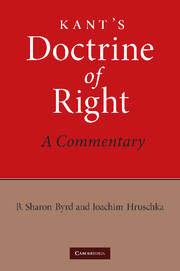
- Kant's Doctrine of RightA Commentary, pp. 279 - 293Publisher: Cambridge University PressPrint publication year: 2010
Accessibility standard: Unknown
Why this information is here
This section outlines the accessibility features of this content - including support for screen readers, full keyboard navigation and high-contrast display options. This may not be relevant for you.Accessibility Information
Accessibility compliance for the PDF of this chapter is currently unknown
and may be updated in the future.