PART III - VIRGIL'S GEORGICS
Published online by Cambridge University Press: 03 May 2010

Summary
Much excellent work has been done on the poetic influences on Virgil's Georgics. My goal in this section is not to discount the importance of these poetic models but simply to reintegrate equally important sources of inspiration for the Georgics, namely Xenophon's and Varro's philosophical dialogues on farming. The Georgics has frequently been read as a generically self-conscious work, but when that genre is limited to didactic poetry, the reader loses sight of aspects of the work that might be read profitably against the background of philosophical satire and dialogue. In particular, I would suggest that connecting the Georgics to works like the Oeconomicus and De Re Rustica usefully recontextualizes the parodic, ironic, and satiric aspects of the Georgics, as well as its use of polyphony, allegory, and the contrast between the active and contemplative life. More importantly, it highlights what Virgil does differently with these common devices of Socratic dialogue (and Menippean satire). While all three works require the careful attention of the reader to sort out the attitude of the author towards the different voices in the work, Virgil perhaps trumps them all in his destabilization of the authorial voice and in the challenges of his polyphony. In the following two chapters, I propose one specific way of making sense of the dialogue between the voices in the text and beyond the text, while at the same time acknowledging that “the diversity of compelling interpretations is part of the Georgics' larger value and meaning” (Batstone [1997] 125).
Information
- Type
- Chapter
- Information
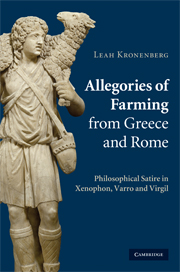
- Allegories of Farming from Greece and RomePhilosophical Satire in Xenophon, Varro, and Virgil, pp. 131Publisher: Cambridge University PressPrint publication year: 2009
Accessibility standard: Unknown
Why this information is here
This section outlines the accessibility features of this content - including support for screen readers, full keyboard navigation and high-contrast display options. This may not be relevant for you.Accessibility Information
Accessibility compliance for the PDF of this chapter is currently unknown
and may be updated in the future.