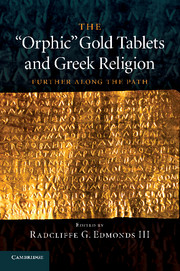
Book contents
- Frontmatter
- Contents
- List of contributors
- Acknowledgements
- Note on abberivations
- PART I THE TABLET TEXTS
- PART II TEXTS AND CONTEXTS
- PART III SEMIOTIC AND NARRATIVE ANALYSES
- 8 Funerary gold lamellae and Orphic papyrus commentaries
- 9 Initiation – death – underworld
- 10 Sacred scripture or oracles for the dead?
- 11 Dialogues of immortality from the Iliad to the gold leaves
- 12 Poetry and performance in the Orphic gold leaves
- 13 Rushing into milk
- Compiled Bibliography
- Index
- Index locorum
8 - Funerary gold lamellae and Orphic papyrus commentaries
Same use, different purpose
Published online by Cambridge University Press: 04 February 2011
Edited by

Book contents
- Frontmatter
- Contents
- List of contributors
- Acknowledgements
- Note on abberivations
- PART I THE TABLET TEXTS
- PART II TEXTS AND CONTEXTS
- PART III SEMIOTIC AND NARRATIVE ANALYSES
- 8 Funerary gold lamellae and Orphic papyrus commentaries
- 9 Initiation – death – underworld
- 10 Sacred scripture or oracles for the dead?
- 11 Dialogues of immortality from the Iliad to the gold leaves
- 12 Poetry and performance in the Orphic gold leaves
- 13 Rushing into milk
- Compiled Bibliography
- Index
- Index locorum
Summary
OFFICIAL RELIGIOUS DISCOURSES AND MYSTICAL DISCOURSES
French anthropologists studying ancient Greek religion have readily interpreted the theological re-elaborations and religious practices of the Pythagoreans and the Orphics in terms of inversion and subversion: inversion of the path of cosmo- and theogonic creation to return from multiplicity and disparity to unity; subversion of the official sacrificial acts of animals through different forms of vegetarianism. Generally considered as autonomous systems of signification, the corresponding texts have been cut off in their reading and interpretation by modern readers from the circumstances of their production and performance. The attention brought to long poems seen as literary texts has often been accompanied by a certain disregard for the discursive practices of the “sectarians” themselves. In these practices, spoken words often held value as acts of worship, being accompanied by written records which have been restored to us with surprising regularity as the excavations progress, particularly from funerary sites.
Among the texts deposited near the remains of the deceased, there are two that are both from a similar time period (end of the fourth century) and from neighboring locations (Macedonia/Thessaly). One is the well-known “Derveni Papyrus,” excavated in 1962 from a cist-grave of a soldier near Thessaloniki and whose official publication is now finally completed; and the other is the pair of gold lamellae found in 1985 in a grave for a woman on the site thought to be ancient Pelinna.
Information
- Type
- Chapter
- Information
- The 'Orphic' Gold Tablets and Greek ReligionFurther along the Path, pp. 203 - 218Publisher: Cambridge University PressPrint publication year: 2011
Accessibility standard: Unknown
Why this information is here
This section outlines the accessibility features of this content - including support for screen readers, full keyboard navigation and high-contrast display options. This may not be relevant for you.Accessibility Information
Accessibility compliance for the PDF of this chapter is currently unknown
and may be updated in the future.
- 3
- Cited by