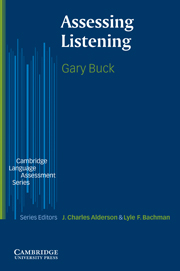
Book contents
- Frontmatter
- Contents
- Series Editors' Preface
- Acknowledgements
- 1 An overview of listening comprehension
- 2 What is unique to listening
- 3 Approaches to assessing listening
- 4 Defining the construct
- 5 Creating tasks
- 6 Providing suitable texts
- 7 Designing and constructing complete assessments
- 8 Illustrative tests of listening comprehension
- 9 Summary and future developments
- Bibliography
- Index
Book contents
- Frontmatter
- Contents
- Series Editors' Preface
- Acknowledgements
- 1 An overview of listening comprehension
- 2 What is unique to listening
- 3 Approaches to assessing listening
- 4 Defining the construct
- 5 Creating tasks
- 6 Providing suitable texts
- 7 Designing and constructing complete assessments
- 8 Illustrative tests of listening comprehension
- 9 Summary and future developments
- Bibliography
- Index
Summary
The assessment of listening abilities is one of the least understood, least developed and yet one of the most important areas of language testing and assessment. It is important because of the potential wash-back effect onto classroom practices. After all, if we do not test the ability to understand spoken discourse in the second or foreign language, why would learners take seriously the need to develop and improve their listening comprehension? Even if teachers might be convinced of the importance of listening as a language-use activity, they will perhaps inevitably tend to concentrate on those specific aspects of listening that are eventually tested. Indeed, some have argued that it is crucial to test listening in settings where tests of speaking cannot be administered for practical and logistical reasons. The argument is that by teaching listening (in preparation for the test), teachers will necessarily have to engage in some sort of speaking activity in class, even if speaking itself is not assessed.
Thus, from a pedagogic point of view, the assessment of listening is central to our need to teach as well as to assess language proficiency.
It is all the more curious, therefore, that very little is written in the language assessment literature on the specific constructs, or abilities, that underlie listening, on how to go about designing listening assessment procedures, on how to validate and evaluate listening tests.
Information
- Type
- Chapter
- Information
- Assessing Listening , pp. x - xiPublisher: Cambridge University PressPrint publication year: 2001
Accessibility standard: Unknown
Why this information is here
This section outlines the accessibility features of this content - including support for screen readers, full keyboard navigation and high-contrast display options. This may not be relevant for you.Accessibility Information
Accessibility compliance for the PDF of this chapter is currently unknown
and may be updated in the future.