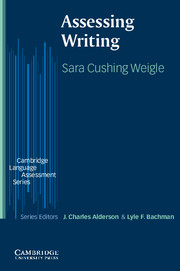
Book contents
- Frontmatter
- Contents
- Series Editors' Preface
- Acknowledgements
- 1 Introduction
- 2 The nature of writing ability
- 3 Basic considerations in assessing writing
- 4 Research in large-scale writing assessment
- 5 Designing writing assessment tasks
- 6 Scoring procedures for writing assessment
- 7 Illustrative tests of writing
- 8 Beyond the timed impromptu test: Classroom writing assessment
- 9 Portfolio assessment
- 10 The future of writing assessment
- Bibliography
- Index
2 - The nature of writing ability
Published online by Cambridge University Press: 03 May 2010

Book contents
- Frontmatter
- Contents
- Series Editors' Preface
- Acknowledgements
- 1 Introduction
- 2 The nature of writing ability
- 3 Basic considerations in assessing writing
- 4 Research in large-scale writing assessment
- 5 Designing writing assessment tasks
- 6 Scoring procedures for writing assessment
- 7 Illustrative tests of writing
- 8 Beyond the timed impromptu test: Classroom writing assessment
- 9 Portfolio assessment
- 10 The future of writing assessment
- Bibliography
- Index
Summary
Introduction
In Chapter 1, the role of writing in second-language learning was explored. In this chapter, we turn to a consideration of the nature of writing ability. Denning the skill that we want to test is a critical starting point in designing a test, and, as we shall see, the definition of writing ability for a particular context will depend in large measure on the considerations discussed in Chapter 1: that is, the specific group of second-language writers and the type of writing that these writers are likely to engage in.
This chapter looks at the nature of writing ability from several perspectives: first, in comparison with the other so-called productive skill of speaking, next as a social and cultural phenomenon, then as a cognitive activity. Finally, the relationship between writing and second-language proficiency is discussed.
The relationship between writing and speaking
It is traditional in language teaching and testing to categorize instances of language use into four skills: reading, writing, listening, and speaking, using channel (aural versus visual) and mode (productive versus receptive). The extent to which these different skills actually involve different cognitive mechanisms or are simply various socio-culturally mediated manifestations of a more general language ability is a matter of some controversy. While a full treatment of this issue is beyond the scope of this volume, in coming up with a definition of writing that can be useful for assessment it may be worthwhile spending some time considering the relationship between writing and the two skills most closely related to it: speaking (the other productive skill) and reading (the other visual skill).
Information
- Type
- Chapter
- Information
- Assessing Writing , pp. 14 - 38Publisher: Cambridge University PressPrint publication year: 2002
Accessibility standard: Unknown
Why this information is here
This section outlines the accessibility features of this content - including support for screen readers, full keyboard navigation and high-contrast display options. This may not be relevant for you.Accessibility Information
Accessibility compliance for the PDF of this chapter is currently unknown
and may be updated in the future.