Book contents
- Frontmatter
- Contents
- Preface
- Acknowledgements
- PART I History
- 1 Victors' justice
- 2 Above it all
- 3 Reading their rights
- 4 From victim to suspect
- 5 Farewell sovereignty
- 6 No law at all
- 7 The sound of silence
- 8 The spark in the ashes
- 9 Wringing out the fault
- 10 Everything and nothing
- 11 Skulls and crossbones
- PART II Law
- PART III Justice
- Index
2 - Above it all
Published online by Cambridge University Press: 05 June 2012

Book contents
- Frontmatter
- Contents
- Preface
- Acknowledgements
- PART I History
- 1 Victors' justice
- 2 Above it all
- 3 Reading their rights
- 4 From victim to suspect
- 5 Farewell sovereignty
- 6 No law at all
- 7 The sound of silence
- 8 The spark in the ashes
- 9 Wringing out the fault
- 10 Everything and nothing
- 11 Skulls and crossbones
- PART II Law
- PART III Justice
- Index
Summary
This was a review, published in the London Review of Books in 1994, of two innovative books. One, Suing Judges, by a young academic, Abimbola Olowofoyeku, who went on to achieve distinction, was a comparative study of what some regard as anomalous and others as essential to the administration of justice – the immunity of judges from lawsuits. The other, The Independence of the Judiciary,was the product of a trawl by the veteran Anglo-American scholar Robert Stevens through the Lord Chancellor's archives, set in a matrix of constitutional law.
Some of the reflections prompted by the two volumes on the constitutional position and role of the judiciary have been borne out in the developments of subsequent years.
For some reason the Mansion House was not struck by a thunderbolt on the night in 1936 when the Chief Justice, Lord Hewart, told the guests at the Lord Mayor's Dinner: ‘His Majesty's Judges are satisfied with the almost universal admiration in which they are held.’ Or, for that matter, on the same occasion in 1953 when the Lord Mayor told the diners: ‘Her Majesty's judges have a greater understanding of human nature than any other body of men in the world.’
But who is to judge the judges? Well, there's the Court of Appeal, and beyond it the Judicial Committee of the House of Lords, both of them capable of rapping judicial knuckles and occasionally drawing blood: but they're just more judges.
Information
- Type
- Chapter
- Information
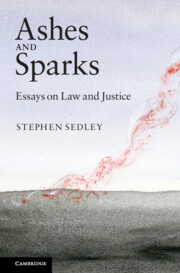
- Ashes and SparksEssays On Law and Justice, pp. 17 - 28Publisher: Cambridge University PressPrint publication year: 2011
Accessibility standard: Unknown
Why this information is here
This section outlines the accessibility features of this content - including support for screen readers, full keyboard navigation and high-contrast display options. This may not be relevant for you.Accessibility Information
Accessibility compliance for the PDF of this chapter is currently unknown
and may be updated in the future.