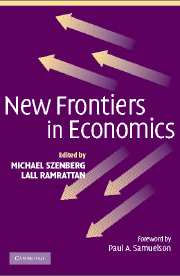
Book contents
- Frontmatter
- Contents
- List of Contributors
- Foreword by Paul A. Samuelson
- Preface
- Acknowledgments
- Introduction
- PART I INFORMATIONAL BEHAVIORAL ECONOMICS AND FINANCE
- PART II MACROECONOMICS AND PUBLIC POLICIES
- PART III INTERNATIONAL TRADE AND DEVELOPMENT
- PART IV CONTRACTS, LAW, AND GAMING
- 9 Contract or War? On the Consequences of a Broader View of Self-Interest in Economics
- 10 New Directions in Law and Economics
- Author Index
- Subject Index
- References
10 - New Directions in Law and Economics
Published online by Cambridge University Press: 06 July 2010

Book contents
- Frontmatter
- Contents
- List of Contributors
- Foreword by Paul A. Samuelson
- Preface
- Acknowledgments
- Introduction
- PART I INFORMATIONAL BEHAVIORAL ECONOMICS AND FINANCE
- PART II MACROECONOMICS AND PUBLIC POLICIES
- PART III INTERNATIONAL TRADE AND DEVELOPMENT
- PART IV CONTRACTS, LAW, AND GAMING
- 9 Contract or War? On the Consequences of a Broader View of Self-Interest in Economics
- 10 New Directions in Law and Economics
- Author Index
- Subject Index
- References
Summary
Law and economics began at the University of Chicago with the pioneering work of Henry Simons in the tax area and Aaron Director on antitrust. Ronald Coase contributed “The Problem of Social Cost,” sometimes said to be the most cited article in the history of economics, and launched the serious study of tort and property law from the economic perspective. The antitrust mantle was carried forward by such Chicago-connected scholars as Robert Bork, Frank Easterbrook, William Landes, and Richard Posner. Their critique of antitrust doctrine as it had emerged in the 1960s and 1970s revolutionized the field, so much so that Robert Bork claims substantial victory for Chicago school ideas in the afterword to the most recent edition of The Antitrust Paradox. Guido Calabresi at Yale introduced basic ideas of economics to the field of accident law, as Landes, Posner, and Steven Shavell at Harvard also labored to understand the economic implications of negligence, strict liability, joint and several liability, and other central features of tort doctrine. Serious work on contract law soon followed, such as Shavell's seminal work on contract remedies. The corporate area was also a natural target for economically oriented research. Chicago scholars Easterbrook and Daniel Fischel focused on the law governing changes in corporate control, for example, while Ralph Winter at Yale thoughtfully rebutted the suggestion that the state of Delaware had led corporate law racing toward the bottom, and Henry Manne wondered about the logic of insider trading rules.
Information
- Type
- Chapter
- Information
- New Frontiers in Economics , pp. 281 - 302Publisher: Cambridge University PressPrint publication year: 2004
References
(1999), “The Aggregate Burden of Crime,” Journal of Law and Economics 42, 611–42CrossRefGoogle Scholar
(1968), “Crime and Punishment: An Economic Approach,” Journal of Political Economy 76, 169–217CrossRefGoogle Scholar
and (2002), “Insurance Fraud and Optimal Claims Settlement Strategies,” Journal of Law and Economics469–508CrossRefGoogle Scholar
and (2001), “Workers' Compensation Rate Regulation: How Price Controls Increase Costs,” Journal of Law and Economics 44, 1–36CrossRefGoogle Scholar
and (2001a), “The Impact of Legalized Abortion on Crime,” Quarterly Journal of Economics 116, 379–420CrossRefGoogle Scholar
and (2001b), “The Impact of Race on Policing and Arrests,” Journal of Law and Economics 44, 367–94CrossRefGoogle Scholar
Eaton, Jonathan and Sykes, Alan (1998), “International Sanctions,” in New Palgrave Dictionary of Economics and the Law Vol. II, , ed. (New York: Stockton Press), 352–9CrossRefGoogle Scholar
(1999), “Exit Rights and Insurance Regulation: From Federalism to Takings,”George Mason Law Review 7, 293–511Google Scholar
and (1999), “Why Is There More Crime in Cities?”Journal of Political Economy 107, S225–S258CrossRefGoogle Scholar
and (1999), “A Theory of Customary International Law,” University of Chicago Law Review 66, 1113–77CrossRefGoogle Scholar
(1994), “Evidence of Capacity Constraints in Insurance Markets,” Journal of Law and Economics 37, 349–77CrossRefGoogle Scholar
and (1995a), “Trade Wars and Trade Talks,” Journal of Political Economy 103, 675–708CrossRefGoogle Scholar
and (1995b), “The Politics of Free Trade Agreements,” American Economic Review 85, 667–90Google Scholar
and (1999), “Shaming White Collar Criminals: A Proposal for the Reform of the Federal Sentencing Guidelines,” Journal of Law and Economics 42, 365–91CrossRefGoogle Scholar
and (1993), “The Reputational Penalty Firms Bear for Committing Criminal Fraud,” Journal of Law and Economics 36, 757–802CrossRefGoogle Scholar
and (1999), “Using Sentence Enhancements to Distinguish Between Deterrence and Incapacitation,” Journal of Law and Economics 42, 343–64CrossRefGoogle Scholar
(1997), “Incentive Compatibility Constraints as an Explanation for the Use of Prison Sentences Instead of Fines,” International Review of Law and Economics 17, 179–92CrossRefGoogle Scholar
and (2001), “How Dangerous Are Drinking Drivers?”Journal of Political Economy 109, 1198–1237CrossRefGoogle Scholar
and (1997), “Crime, Deterrence and Right to Carry Concealed Handguns,” Journal of Legal Studies 26, 1–68CrossRefGoogle Scholar
and (2001), “The Lethal Effects of Three-Strikes Laws, Journal of Legal Studies 30, 89–106CrossRefGoogle Scholar
(1992), “The Gains from Faith in an Unfaithful Agent: Settlement Conflicts Between Defendants and Liability Insurers,” Journal of Law, Economics and Organization 8, 502–22Google Scholar
(2001), “Racial, Ethnic and Gender Disparities in Sentencing: Evidence from the U.S. Federal Courts,” Journal of Law and Economics 44, 285–314CrossRefGoogle Scholar
and (1993), “Should Employees Be Subject to Finds and Imprisonment Given the Existence of Corporate Liability?”International Review of Law and Economics 13, 239–57CrossRefGoogle Scholar
and (1998), “Punitive Damages: An Economic Analysis,” Harvard Law Review 111, 869–962CrossRefGoogle Scholar
(1996), “The Government, The Market and the Problem of Catastrophic Loss,”Journal of Risk and Uncertainty 12, 219–37CrossRefGoogle Scholar
(1996), “Stigma and Self-Fulfilling Expectations of Criminality,”Journal of Law and Economics 39, 519–43CrossRefGoogle Scholar
(1993), “The Economics of Insurance Law,” International Review of Law and Economics 13, 145–62CrossRefGoogle Scholar
Snidal, Duncan (1997), “International Political Economy Approaches to International Institutions,” in Economic Dimensions in International Law, and , eds. (Cambridge: Cambridge Press), 477–512Google Scholar
and (1996), “Toward a Positive Theory of the Most Favored Nation Obligation and Its Exceptions in the WTO/GATT System,” International Review of Law and Economics 16, 27–52CrossRefGoogle Scholar
and (2002), “The Economic Structure of Renegotiation and Dispute Settlement in the WTO/GATT System,” Journal of Legal Studies Vol. 31, S179–S204Google Scholar
(1994), “Bad Faith Refusal to Settle by Liability Insurers: Some Implications of the Judgment Proof Problem, Journal of Legal Studies 23, 77–110CrossRefGoogle Scholar
(1999), “Regulatory Protectionism and the Law of International Trade,” University of Chicago Law Review 66, 1–46CrossRefGoogle Scholar
Sykes, Alan (2000), “International Trade,” in Encyclopedia of Law and Economics Vol. III, and , eds. (Northampton, MA: Edward Elgar), 1114–32Google Scholar
(1970), “The Optimum Enforcement of Law,” Journal of Political Economy 78, 1526–36CrossRefGoogle Scholar
Accessibility standard: Unknown
Why this information is here
This section outlines the accessibility features of this content - including support for screen readers, full keyboard navigation and high-contrast display options. This may not be relevant for you.Accessibility Information
Accessibility compliance for the PDF of this chapter is currently unknown
and may be updated in the future.