Book contents
- Frontmatter
- Contents
- Acknowledgments
- List of Abbreviations
- Introduction: The Extraordinary and Political Theory
- I CHARISMATIC POLITICS AND THE SYMBOLIC FOUNDATIONS OF POWER
- II THE EXCEPTION AND CONSTITUTIONAL POLITICS
- 4 The Popular Constituent Sovereign and the Pure Theory of Democratic Legitimacy
- 5 Toward a Theory of Democratic Constitutionalism
- 6 The Extra-Institutional Sovereign
- III TAMING THE EXTRAORDINARY
- Conclusion: A Democratic Theory of the Extraordinary
- Bibliography
- Index
- References
5 - Toward a Theory of Democratic Constitutionalism
Published online by Cambridge University Press: 04 August 2010

Book contents
- Frontmatter
- Contents
- Acknowledgments
- List of Abbreviations
- Introduction: The Extraordinary and Political Theory
- I CHARISMATIC POLITICS AND THE SYMBOLIC FOUNDATIONS OF POWER
- II THE EXCEPTION AND CONSTITUTIONAL POLITICS
- 4 The Popular Constituent Sovereign and the Pure Theory of Democratic Legitimacy
- 5 Toward a Theory of Democratic Constitutionalism
- 6 The Extra-Institutional Sovereign
- III TAMING THE EXTRAORDINARY
- Conclusion: A Democratic Theory of the Extraordinary
- Bibliography
- Index
- References
Summary
“Schmitt,” Stephen Holmes writes, “subscribed to the myth of a fundamental opposition between constitutional limitations and democratic government.…Schmitt's democratic mysticism, not to mention its practical consequences, suffices to discredit this entire approach. It is meaningless to speak about popular government apart from some sort of legal framework which enables the electorate to have a coherent will.” According to this line of interpretation, Schmitt sought to replace constitutionalism and a stable legal system with an immutable, boundless sovereign constituent power, often incarnated in a dictatorial president, ruling by arbitrary executive decrees and administrative orders. Schmitt's critique of the rule of law, the separation of powers, and of normative legal formalism, so this argument goes, is part of a broader, more ambitious attempt to abolish constitutionalism. Schmitt's appeal to a fictional constituent subject is seen as a pretext for the establishment of an executive dictatorship. Not only did he abhor liberalism; he also sought to undermine and destroy the idea of the constitution as government under law in order to replace it with a permanent state of exception and a normless emergency.
As I try to show in this chapter, these charges lose considerable force and cannot be consistently sustained once we take into consideration two crucial aspects of Schmitt's theory. The first is his stark, clear-cut distinction between the people in an extraconstitutional outside and the people within the constitution, or, to put it in more general terms, between the constituent people and the constituted people.
Information
- Type
- Chapter
- Information
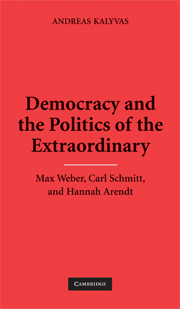
- Democracy and the Politics of the ExtraordinaryMax Weber, Carl Schmitt, and Hannah Arendt, pp. 127 - 162Publisher: Cambridge University PressPrint publication year: 2008
References
, “Legal Indeterminacy and the Origins of Nazi Legal Thought: The Case of Carl Schmitt,” History of Political Thought, 17:4 (1996), pp. 571–590Google Scholar
and , “The Politics of Constitutional Revision in Eastern Europe,” in Responding to Imperfection: The Theory and Practice of Constitutional Amendment, ed. , Princeton: Princeton University Press, 1995, pp. 302–303.Google Scholar
, “Staatsethik und pluralistischer Staat,” in Positionen und Begriffe im Kampf mit Weimar-Genf-Versailles 1923–1939, Berlin: Duncker und Humblot, 1988, p. 155.Google Scholar
, “Identity and Hegemony: The Role of Universality in the Constitution of Political Logics,” in , , and , Contingency, Hegemony, Universality: Contemporary Dialogues on the Left, London: Verso, 2000, p. 54.Google Scholar
, The Ticklish Subject: The Absent Center of Political Ontology, London: Verso, 1999, p. 114Google Scholar
, “Carl Schmitt in the Age of Post-Politics,” in The Challenge of Carl Schmitt, ed. , London: Verso, 1999, pp. 18–19.Google Scholar
, On What the Constitution Means, Baltimore: John Hopkins University Press, 1984, p. 43Google Scholar
, “An Ordering of Constitutional Values,” Southern California Law Review, 53 (1980), p. 755Google Scholar
, “The Legitimacy of Constitutional Change: Rethinking the Amending Process,” Harvard Law Review, 97 (1983), p. 43CrossRefGoogle Scholar
and , État, constitution, loi, Paris: Éditions de l'Espace Européene, 1991, pp. 81–84.Google Scholar
, “The Sociology of the State: Carl Schmitt and Max Weber,” State, Culture, and Society, 1 (1985), pp. 3–57.Google Scholar
, Elements of the Philosophy of Right, ed. , trans. , Cambridge: Cambridge University Press, 1991, pp. 220–275.Google Scholar
, Les révolutions des pouvoirs. La souveraineté, le peuple et la représentation: 1789–1799, Paris: Editions Gallimard, 1992Google Scholar
, La religion dans la democratie. Parcours de la laiçite, Paris: Gallimard, 1998, pp. 111–127Google Scholar
, The Concept of Representation, Berkeley: University of California Press, 1967, pp. 168–189.Google Scholar
, Sovereignty and Its Discontents: The Primacy of Conflict and the Structure of the Political, London: Birkbeck Law Press, 2004, p. 17.Google Scholar
informative study on lottery and democracy in The Principles of Representative Government, Cambridge: Cambridge University Press, 1997, pp. 8–132.CrossRefGoogle Scholar
, Politischer Mehrwert: Eine Studie über Max Weber und Carl Schmitt, Weinheim: VCH Acta humaniora, 1991Google Scholar
, Die Legitimitat der Moderne: Kulturkritik und Herrschaftskonzeption bei Max Weber und Carl Schmitt, Merburg: Tectum Verlag, 1994.Google Scholar
, introduction to Law as Politics: Carl Schmitt's Critique of Liberalism, ed. , Durham: Duke University Press, 1998, p. 11.Google Scholar
, Politische Theologie II. Die Legende von der Erledigung jeder Politischen Theologie, Berlin: Duncker und Humblot, 1970, pp. 41–42.Google Scholar
and , “Liberalism and Emergency Powers in Latin American. Reflections on Carl Schmitt and the Theory of Constitutional Dictatorship,” Cardozo Law Review, 21:5–6 (2000), p. 1821.Google Scholar
, Hegel, Carl Schmitt. Le politique entre spéculation et positivité, Paris: PUF, 1992, pp. 261–323.Google Scholar
Accessibility standard: Unknown
Why this information is here
This section outlines the accessibility features of this content - including support for screen readers, full keyboard navigation and high-contrast display options. This may not be relevant for you.Accessibility Information
Accessibility compliance for the PDF of this chapter is currently unknown
and may be updated in the future.