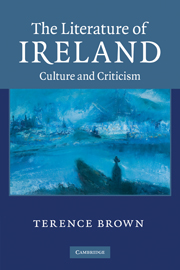
Book contents
- Frontmatter
- Contents
- Acknowledgements
- Introduction
- 1 The Literary Revival: historical perspectives
- 2 Joyce's magic lantern
- 3 Music: the cultural issue
- 4 Modernism and revolution: rereading Yeats's ‘Easter 1916’
- 5 Shakespeare and the Irish self
- 6 Irish literature and the Great War
- 7 Ireland, Modernism and the 1930s
- 8 Post-modernists: Samuel Beckett and Flann O'Brien
- 9 Patrick Kavanagh: religious poet
- 10 MacNeice's Irelands: MacNeice's islands
- 11 Louis MacNeice and the Second World War
- 12 MacNeice and the puritan tradition
- 13 John Hewitt and memory: a reflection
- 14 Michael Longley and the Irish poetic tradition
- 15 Seamus Heaney: the witnessing eye and the speaking tongue
- 16 Derek Mahon: the poet and painting
- 17 Telling tales: Kennelly's Cromwell and Muldoon's ‘The More a Man Has the More a Man Wants’
- 18 Redeeming the time: John McGahern and John Banville
- 19 ‘Have we a context?’: transition, self and society in the theatre of Brian Friel
- 20 Hubert Butler and nationalism
- 21 The Irish Dylan Thomas: versions and influences
- Index
- References
1 - The Literary Revival: historical perspectives
Published online by Cambridge University Press: 05 June 2012

Book contents
- Frontmatter
- Contents
- Acknowledgements
- Introduction
- 1 The Literary Revival: historical perspectives
- 2 Joyce's magic lantern
- 3 Music: the cultural issue
- 4 Modernism and revolution: rereading Yeats's ‘Easter 1916’
- 5 Shakespeare and the Irish self
- 6 Irish literature and the Great War
- 7 Ireland, Modernism and the 1930s
- 8 Post-modernists: Samuel Beckett and Flann O'Brien
- 9 Patrick Kavanagh: religious poet
- 10 MacNeice's Irelands: MacNeice's islands
- 11 Louis MacNeice and the Second World War
- 12 MacNeice and the puritan tradition
- 13 John Hewitt and memory: a reflection
- 14 Michael Longley and the Irish poetic tradition
- 15 Seamus Heaney: the witnessing eye and the speaking tongue
- 16 Derek Mahon: the poet and painting
- 17 Telling tales: Kennelly's Cromwell and Muldoon's ‘The More a Man Has the More a Man Wants’
- 18 Redeeming the time: John McGahern and John Banville
- 19 ‘Have we a context?’: transition, self and society in the theatre of Brian Friel
- 20 Hubert Butler and nationalism
- 21 The Irish Dylan Thomas: versions and influences
- Index
- References
Summary
At the sixth Annual Conference of the Canadian Association for Irish Studies held in Montreal in March, 1973, Seamus Deane delivered a lecture entitled ‘The Literary Myths of the Revival: A Case for Their Abandonment’. This was less than three years after the founding meeting of the International Association for the Study of Anglo-Irish literature, now IASIL, in the summer of 1970 at Trinity College, Dublin. At that Dublin meeting, the Northern Troubles, in their earliest phase, scarcely registered. No one seemed surprised. By 1973 with Bloody Sunday in Derry, Bloody Friday in Belfast, with internment poisoning the communities in Northern Ireland and the Provisonal IRA in the midst of a bombing campaign, it would by contrast have seemed surprising if a meeting dedicated to Irish Studies had not heard something bearing on the developing Irish imbroglio. Deane, with severe passion (I remember the tone precisely in the grand ‘colonial’ chamber in McGill University's Great Hall, in a city that knew its own kind of ethnic and linguistic divisions), spoke of ‘our present delapidated situation’ that had ‘borne in upon us more fiercely than ever the fact that discontinuity, the discontinuity that is ineluctably an inheritance of a colonial history, is more truly the signal feature of our condition’. Deane's lecture, which was published in 1977, set literary historians the task of unmasking what he thought were the disabling Yeatsian myths of the Irish literary revival, which had for too long enjoyed the status of literal truth.
Information
- Type
- Chapter
- Information
- The Literature of IrelandCulture and Criticism, pp. 14 - 26Publisher: Cambridge University PressPrint publication year: 2010
References
, ‘The Literary Myths Of the Revival: A Case For Their Abandonment’, in (ed.), Myth and Reality in Irish Literature (Waterloo, Ontario: Wilfred Laurier University Press, 1977)Google Scholar
, Decolonisation and Criticism: The Construction of Irish Literature (London and Sterling, VA: Pluto Press, 1998), p. 73Google Scholar
and , Writing Ireland: Colonialism, Nationalism and Culture (Manchester University Press, 1988), pp. 89–90Google Scholar
, Yeats's Nations: Gender, Class and Irishness (Cambridge University Press, 1998), pp. 5–6Google Scholar
, Heathcliff and the Great Hunger: Studies in Irish Culture (London and New York: Verso, 1995), p. 271Google Scholar
, ‘Protestant Magic: W. B. Yeats and the Spell of Irish History’, Proceedings of the British Academy, 75 (1989)Google Scholar
, W. B. Yeats: A Life, Vol. I: The Apprentice Mage (Oxford University Press, 1997), p. 50Google Scholar
, Yeats's Nations, E. Cullingford, Gender and History in Yeats's Love Poetry (Cambridge University Press, 1993)Google Scholar
, Yeats's Worlds: Ireland, England and the Poetic Imagination (New Haven and London: Yale University Press, 1995)Google Scholar
, The Origins of Modernism; Eliot, Pound, Yeats and the Rhetoric of Renewal (London: Harvester Wheatsheaf, 1994)Google Scholar
Accessibility standard: Unknown
Why this information is here
This section outlines the accessibility features of this content - including support for screen readers, full keyboard navigation and high-contrast display options. This may not be relevant for you.Accessibility Information
Accessibility compliance for the PDF of this chapter is currently unknown
and may be updated in the future.
- 2
- Cited by