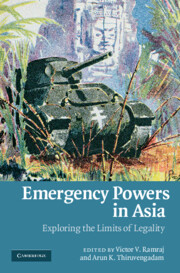
Book contents
- Frontmatter
- Contents
- List of contributors
- Preface
- 1 Introduction: emergency powers and constitutionalism in Asia
- PART I Perspectives from legal and political theory
- PART II Postcolonial and post-conflict transitions
- 6 From Myanmar to Manila: a brief study of emergency powers in Southeast Asia
- 7 Discourses of emergency in colonial and postcolonial Burma
- 8 Emergency and Islamic law in Aceh
- 9 UNaccountable? The United Nations, emergency powers and the rule of law in Asia
- PART III Emergencies, executive power and constitutional order
- PART IV The role of the courts
- Index
- References
7 - Discourses of emergency in colonial and postcolonial Burma
from PART II - Postcolonial and post-conflict transitions
Published online by Cambridge University Press: 04 August 2010

Book contents
- Frontmatter
- Contents
- List of contributors
- Preface
- 1 Introduction: emergency powers and constitutionalism in Asia
- PART I Perspectives from legal and political theory
- PART II Postcolonial and post-conflict transitions
- 6 From Myanmar to Manila: a brief study of emergency powers in Southeast Asia
- 7 Discourses of emergency in colonial and postcolonial Burma
- 8 Emergency and Islamic law in Aceh
- 9 UNaccountable? The United Nations, emergency powers and the rule of law in Asia
- PART III Emergencies, executive power and constitutional order
- PART IV The role of the courts
- Index
- References
Summary
Introduction
The notion of emergency has come to have a wide range of meanings and understandings that have stretched the range of possibilities for socio-legal research. Although emergency can refer to extraordinary medical, environmental, financial, and even perceived cultural crises, it is often discussed within the arena of politics and the law. Conceptually, emergency might be situated anywhere between that which is considered ‘normal’ and that which is considered ‘exceptional’, suggesting a variety of temporal and qualitative conditions that might delineate its parameters. In many respects, the very idea of emergency as an exceptional set of circumstances depends on and enables an understanding of what constitutes ‘non-emergency’ situations. From the perspective of the state (and those officials managing its administrative structures), emergency might be considered a category designed to make threats to society ‘legible’ by incorporating those elements into a familiar vocabulary of governance. For those seeking reform or advocating resistance to the state's definition of the status quo, the conditions associated with emergency can certainly come to mean very different things. It is the socio-legal context underlying this ambiguity that makes the defining of emergency (and conversely the defining of normality) in different cultural-political settings a provocative area of comparative research.
Information
- Type
- Chapter
- Information
- Emergency Powers in AsiaExploring the Limits of Legality, pp. 187 - 212Publisher: Cambridge University PressPrint publication year: 2009
References
, ‘Fifteen Years of Folk Song Collection in Japan: Reports and Recordings of the “Emergency Folk Song Survey”’ (1994) 53 Asian Folklore Studies199CrossRefGoogle Scholar
, Seeing Like a State: How Certain Schemes to Improve the Human Condition Have Failed (New Haven: Yale University Press, 1998), pp. 53–83Google Scholar
and , ‘Introduction: Moral Economy, Capitalism, and State Power in Rural Protest’, in and (eds.), Power and Protest in the Countryside: Studies of Rural Unrest in Asia, Europe, and Latin America (Durham, N. C.: Duke University Press, 1982)Google Scholar
, ‘Emergency Powers and Emergency Regimes: A Commentary’ (1978) 18 Asian Survey401CrossRefGoogle Scholar
, ‘Constitutionalizing Emergency Powers: The British Experience’ (1953) 5 Stanford Law Review382CrossRefGoogle Scholar
, The Jurisprudence of Emergency: Colonialism and the Rule of Law (Ann Arbor: University of Michigan Press, 2003)CrossRefGoogle Scholar
and (eds.), ‘Introduction’, in Law in Times of Crisis: Emergency Powers Constitutionalism in Theory and Practice (Cambridge: Cambridge University Press, 2006)CrossRef
, ‘Nepal in 2002: Emergency and Resurrection of Royal Power’ (2002) 43 Asian Survey208CrossRefGoogle Scholar
, ‘A Season of Caesars: Emergency Regimes and Development Politics in Asia’ (1978) 18 Asian Survey315CrossRefGoogle Scholar
, ‘Capitalism and Counter-Insurgency? Business and Government in the Malayan Emergency 1948–1952’ (1998) 32 Modern Asian Studies149CrossRefGoogle Scholar
and , Democracy and Development in Southeast Asia: The Winds of Change (Boulder, Colo.: Westview, 1995)Google Scholar
(ed.), The Emergence of Southeast Asia (Honolulu: University of Hawaii Press, 2005), pp. 201–68
(ed.) The Cambridge History of Southeast Asia (Cambridge University Press, 1999), vol. II, part 1, pp. 1–72
(ed.), Southeast Asia: A Modern History (New York: Oxford University Press, 2001), pp. 44–96
, Buddhist Backgrounds of the Burmese Revolution (The Hague: Martinus Nijhoff, 1965)CrossRefGoogle Scholar
, The Burma Delta: Economic Development and Social Change on an Asian Frontier 1852–1941 (Madison: University of Wisconsin Press, 1974)Google Scholar
, A Colonial Economy in Crisis: Burma's Cultivators and the World Depression of the 1930s (New York: Routledge/Curzon, 2005)CrossRefGoogle Scholar
, ‘Genealogy of a Rebellion Narrative: Law, Ethnology, and Culture in Colonial Burma’ (2003) 34 Journal of Southeast Asian Studies393CrossRefGoogle Scholar
‘Structuring Revolt: Communities of Interpretation in the Construction of the Saya San Rebellion’ (2008) 39 Journal of Southeast Asia Studies297
, Brave Men of the Hills: Rebellion and Resistance in Burma 1825–1932 (London: Hurst & Co., 2000)Google Scholar
, The Hsaya San Rebellion: Reappraised (Melbourne: Monash University Centre for Southeast Asian Studies Working Papers, 1982)Google Scholar
, Prophets of Rebellion: Millenarian Protest Movements Against the European Colonial Order (Chapel Hill: University of North Carolina Press, 1979)Google Scholar
, The Moral Economy of the Peasant: Rebellion and Subsistence in Southeast Asia (New Haven: Yale University Press, 1977)Google Scholar
, ‘Exceptions, Bare Life, and Colonialism’, in (ed.), Emergency and the Limits of Legality (Cambridge: Cambridge University Press, 2008)Google Scholar
, Making Enemies: War and State Building in Burma (Ithaca: Cornell University Press, 2003)Google Scholar
, Castes of Mind: Colonialism and the Making of Modern India (Princeton: Princeton University Press, 2001)Google Scholar
Accessibility standard: Unknown
Why this information is here
This section outlines the accessibility features of this content - including support for screen readers, full keyboard navigation and high-contrast display options. This may not be relevant for you.Accessibility Information
Accessibility compliance for the PDF of this chapter is currently unknown
and may be updated in the future.
- 2
- Cited by