Book contents
- Frontmatter
- Contents
- List of tables
- Preface
- Acknowledgements
- Note on transliteration
- 1 The dual state in Russia
- 2 Succession struggles and electoral contests
- 3 Political power and factionalism
- 4 A genuinely political economy
- 5 Managed succession
- 6 War of the Putin succession
- 7 Duma selection
- 8 Presidential succession
- 9 Medvedev's challenge
- 10 Conclusion: transcending the dual state
- Bibliography
- Index
9 - Medvedev's challenge
Published online by Cambridge University Press: 05 June 2012

Book contents
- Frontmatter
- Contents
- List of tables
- Preface
- Acknowledgements
- Note on transliteration
- 1 The dual state in Russia
- 2 Succession struggles and electoral contests
- 3 Political power and factionalism
- 4 A genuinely political economy
- 5 Managed succession
- 6 War of the Putin succession
- 7 Duma selection
- 8 Presidential succession
- 9 Medvedev's challenge
- 10 Conclusion: transcending the dual state
- Bibliography
- Index
Summary
Putin was a hard act to follow. In comparison with Yeltsin, Putin enjoyed almost every possible advantage – youth, dynamism and vision – and any successor would labour in his enormous shadow. The double elections for parliament and the presidency gave Russia's leadership a renewed mandate while embedding continuity across the divide. The Medvedev succession remained true to the letter of the constitution: the constitution was not changed, and Putin did not succumb to calls to stay on for a third term. However, Putin remained, but in a new capacity. On 7 May 2008, Medvedev was sworn in as president, and the following day the Duma confirmed Putin as prime minister by an overwhelming majority (392 to 56, with the Communists voting against and two abstentions), and thus the succession operation was complete. The constitution establishes a dual executive (although technically the president stands above the executive), and now this was reinforced by political realities. Even with Putin as prime minister, Russia would not be transformed into a parliamentary republic, but a new centre of power was created outside the Kremlin: a popular prime minister at the head of the dominant party backed by a parliamentary majority. Russia remained a presidential republic, but the role of the government was enhanced since it was now led by an authoritative figure with enormous political capital of his own. Medvedev's election represented the partial triumph of the civiliki and reflected the failure of the security apparatus to consolidate its position.
Information
- Type
- Chapter
- Information
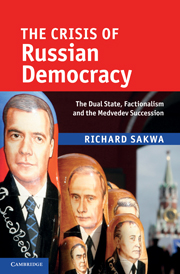
- The Crisis of Russian DemocracyThe Dual State, Factionalism and the Medvedev Succession, pp. 301 - 352Publisher: Cambridge University PressPrint publication year: 2010
Accessibility standard: Unknown
Why this information is here
This section outlines the accessibility features of this content - including support for screen readers, full keyboard navigation and high-contrast display options. This may not be relevant for you.Accessibility Information
Accessibility compliance for the PDF of this chapter is currently unknown
and may be updated in the future.