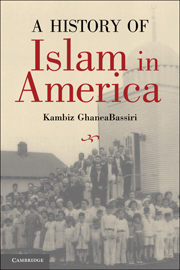
Book contents
- Frontmatter
- Contents
- List of Illustrations
- Acknowledgments
- Introduction
- 1 Islam in the “New World”
- 2 Islamic Beliefs and Practice in Colonial and Antebellum America
- 3 Conflating Race, Religion, and Progress
- 4 Race, Ethnicity, Religion, and Citizenship
- 5 Rooting Islam in America
- 6 Islam and American Civil Religion in the Aftermath of World War II
- 7 A New Religious America and a Post-Colonial Muslim World
- 8 Between Experience and Politics
- Epilogue
- Select Bibliography
- Index
4 - Race, Ethnicity, Religion, and Citizenship
Muslim Immigration at the Turn of the Twentieth Century
Published online by Cambridge University Press: 05 August 2012

Book contents
- Frontmatter
- Contents
- List of Illustrations
- Acknowledgments
- Introduction
- 1 Islam in the “New World”
- 2 Islamic Beliefs and Practice in Colonial and Antebellum America
- 3 Conflating Race, Religion, and Progress
- 4 Race, Ethnicity, Religion, and Citizenship
- 5 Rooting Islam in America
- 6 Islam and American Civil Religion in the Aftermath of World War II
- 7 A New Religious America and a Post-Colonial Muslim World
- 8 Between Experience and Politics
- Epilogue
- Select Bibliography
- Index
Summary
In the hagiographies of Inayat Khan, his arrival in the “West” is explained through a charge his Sufi master gave him when he attained enlightenment: “Go, my child, into the world, harmonize the East and the West with the harmony of thy music; spread the wisdom of Sufism, for thou art gifted by Allah, the most Merciful and Compassionate.” This otherworldly explanation of why Khan came to the United States in 1910 allowed Khan, as we have seen, to transcend the color of his skin and his stigmatized Islamic background. It situated him neatly within the contemporary universalizing discourses of liberal Protestantism and metaphysical religions. It concealed, however, the fact that he left India for the United States at a time when a few thousand north Indians were immigrating to the United States in search of economic opportunities.
The establishment's groping for a cohesive national identity and social order through such universalizing concepts as race, religion, and progress in the nineteenth and early twentieth centuries concealed the actual workings of American industry, commerce, culture, government, and science, most of which were advanced by the diligence and ingenuity not only of white native-born Protestants, but also of immigrants and natives who were not considered white (Irish Catholics, Eastern European Jews, African American Baptists, and others) who made up the mass of American workers, thinkers, and entrepreneurs.
Information
- Type
- Chapter
- Information
- A History of Islam in AmericaFrom the New World to the New World Order, pp. 135 - 164Publisher: Cambridge University PressPrint publication year: 2010
Accessibility standard: Unknown
Why this information is here
This section outlines the accessibility features of this content - including support for screen readers, full keyboard navigation and high-contrast display options. This may not be relevant for you.Accessibility Information
Accessibility compliance for the PDF of this chapter is currently unknown
and may be updated in the future.