Book contents
- Frontmatter
- Contents
- Contributors
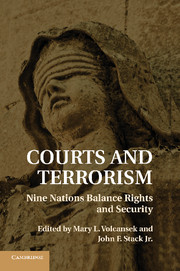
- COURTS AND TERRORISM
- Introduction
- 1 Detentions and Security versus Liberty in Times of National Emergency
- 2 One More Casualty of the “War on Terror”
- 3 State Secrets and Democratic Values
- 4 What Lessons Can Be Drawn from a Sui Generis Case? The Global “War on Terror” and Northern Ireland
- 5 The British Experience with Terrorism: From the IRA to Al Qaeda
- 6 Detention and Treatment of Suspected Terrorists under the European Convention on Human Rights
- 7 Australia's Commonwealth Model and Terrorism
- 8 Judicial Rejection as Substantial Relief: The Israeli Supreme Court and the “War on Terror”
- 9 Preserving Rights and Protecting the Public: The Italian Experience
- 10 Squaring the Circle? Fighting Terror while Consolidating Democracy in Spain
- 11 From Exception to Normalcy: Law, the Judiciary, Civil Rights, and Terrorism in Colombia, 1984–2004
- Conclusion: Lessons Learned
- Cases Cited
- Statutes Cited
- References
- Index
1 - Detentions and Security versus Liberty in Times of National Emergency
Published online by Cambridge University Press: 05 July 2011

Book contents
- Frontmatter
- Contents
- Contributors
- COURTS AND TERRORISM
- Introduction
- 1 Detentions and Security versus Liberty in Times of National Emergency
- 2 One More Casualty of the “War on Terror”
- 3 State Secrets and Democratic Values
- 4 What Lessons Can Be Drawn from a Sui Generis Case? The Global “War on Terror” and Northern Ireland
- 5 The British Experience with Terrorism: From the IRA to Al Qaeda
- 6 Detention and Treatment of Suspected Terrorists under the European Convention on Human Rights
- 7 Australia's Commonwealth Model and Terrorism
- 8 Judicial Rejection as Substantial Relief: The Israeli Supreme Court and the “War on Terror”
- 9 Preserving Rights and Protecting the Public: The Italian Experience
- 10 Squaring the Circle? Fighting Terror while Consolidating Democracy in Spain
- 11 From Exception to Normalcy: Law, the Judiciary, Civil Rights, and Terrorism in Colombia, 1984–2004
- Conclusion: Lessons Learned
- Cases Cited
- Statutes Cited
- References
- Index
Summary
Times of perceived national emergency and “war” bring into bold relief the fundamental tensions between security and liberty, along with those between democratic passions and the exercise of judicial review to enforce the rule of law. Historically, this has been the case in the United States and most recently with the “war against international terrorism.” Throughout the history of the United States – from the founding period to the Civil War, to World Wars I and II, and to the present “war against terrorism” – the president and Congress have tended to curtail, if not at times excessively curb, civil liberties in the asserted interest of safeguarding “national security.” The Supreme Court also has generally, though with some notable exceptions, proven reluctant to second-guess the president and Congress or to defend civil rights and liberties in times of perceived national emergency.
As Justice William J. Brennan Jr. once succinctly observed, the political history of times of perceived national emergency “teaches that the perceived threats to national security that have motivated the sacrifice of civil liberties during times of crisis are often overblown and factually unfounded” (Brennan, 1987: 8). The tendency to overreact, such as by detaining individuals who are perceived as alleged threats to national security, has arguably been grounded in a political tradition of isolationism and reinforced by the country's geographical isolation secured by two great oceans.
Information
- Type
- Chapter
- Information
- Courts and TerrorismNine Nations Balance Rights and Security, pp. 9 - 32Publisher: Cambridge University PressPrint publication year: 2010
Accessibility standard: Unknown
Why this information is here
This section outlines the accessibility features of this content - including support for screen readers, full keyboard navigation and high-contrast display options. This may not be relevant for you.Accessibility Information
Accessibility compliance for the PDF of this chapter is currently unknown
and may be updated in the future.