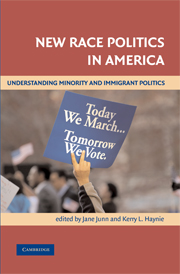
Book contents
- Frontmatter
- Contents
- Contributors
- Acknowledgments
- 1 New Race Politics: The Changing Face of the American Electoral Landscape
- 2 In Whose Interest? Political Parties, Context, and the Incorporation of Immigrants
- 3 Beyond Black and White: The Experiences and Effects of Economic Status among Racial and Ethnic Minorities
- 4 Activity amid Diversity: Asian American Political Participation
- 5 Get Me to the Polls on Time: Coethnic Mobilization and Latino Turnout
- 6 Se Habla Espanol: Ethnic Campaign Strategies and Latino Voting Behavior
- 7 Structuring Group Activism: A Macro Model of Black Participation
- 8 Black Elites and Latino Immigrant Relations in a Southern City: Do Black Elites and the Black Masses Agree?
- 9 Understanding the New Race Politics: Conclusions and Challenges
- References
- Index
5 - Get Me to the Polls on Time: Coethnic Mobilization and Latino Turnout
Published online by Cambridge University Press: 05 September 2012

Book contents
- Frontmatter
- Contents
- Contributors
- Acknowledgments
- 1 New Race Politics: The Changing Face of the American Electoral Landscape
- 2 In Whose Interest? Political Parties, Context, and the Incorporation of Immigrants
- 3 Beyond Black and White: The Experiences and Effects of Economic Status among Racial and Ethnic Minorities
- 4 Activity amid Diversity: Asian American Political Participation
- 5 Get Me to the Polls on Time: Coethnic Mobilization and Latino Turnout
- 6 Se Habla Espanol: Ethnic Campaign Strategies and Latino Voting Behavior
- 7 Structuring Group Activism: A Macro Model of Black Participation
- 8 Black Elites and Latino Immigrant Relations in a Southern City: Do Black Elites and the Black Masses Agree?
- 9 Understanding the New Race Politics: Conclusions and Challenges
- References
- Index
Summary
Until recently, Latinos were nearly invisible on the national political scene, garnering little attention from political parties, candidates, and scholars alike. Much has changed in the last several decades, and Latinos are now the largest minority group in the country, making up more than 12 percent of the U.S. population. With a steady stream of immigrants from Mexico and Latin America, the proportion of Latinos is expected to more than double by mid-century to a quarter of the population. Once small and geographically concentrated in states in the American west and southwest, new patterns of settlement among immigrants to nontraditional gateway metropolitan areas in the United States has resulted in a highly diverse Latino population that is increasingly dispersed across states in the United States. Nevertheless, substantial populations of Latinos reside in five of the most electorally rich states in the United States – California, New York, Texas, Florida, and Illinois – and the dynamics of elections in those states and across the nation simply cannot be understood without accounting for Latino voters (Leighley 2001; Shaw et al. 2000).
Despite the momentous demographic changes and the resulting imperative to understand Latino electoral behavior, surprisingly little is known about how Latino voters are mobilized, and what impact that mobilization has on their voting behavior. In general, political scientists have focused their attention on developing models to explain voting among Anglos and African Americans.
Information
- Type
- Chapter
- Information
- New Race Politics in AmericaUnderstanding Minority and Immigrant Politics, pp. 95 - 113Publisher: Cambridge University PressPrint publication year: 2008
Accessibility standard: Unknown
Why this information is here
This section outlines the accessibility features of this content - including support for screen readers, full keyboard navigation and high-contrast display options. This may not be relevant for you.Accessibility Information
Accessibility compliance for the PDF of this chapter is currently unknown
and may be updated in the future.
- 3
- Cited by