Introduction
Published online by Cambridge University Press: 05 June 2012

Summary
The 1979 Iranian revolution culminating in the Islamic Republic of Iran was an untimely rooster that perplexed analysts, academics and journalists. In the late twentieth century, long after religion had been called the opium of the masses, Islam became the primary mobilizing force of a potent revolutionary ideology, which was to mark indelibly the subsequent three decades of world history. In search of labelling, understanding and naming the events in Iran, a flurry of Western neologisms were coined. Epithets such as fundamentalism, with a Christian genealogy, were excavated and soon became household terms designating this “new brand” of Islam. Islam was made out to be a uniform and undifferentiated monolith. This blanket concept, most suitable for rhetorical tagging, concealed the most rudimentary differences among Muslims. It placed the Sunnis and Shiʿis and their different subsets along with the mystics and Sufis, with their own multiple offshoots, and the modernists and traditionalists, only to mention a few, in the same jar and slapped a single label on it.
At the risk of schematizing, the encounter between nascent neo-conservative Western governments, taken off guard, and the Islamic resurgence can be outlined in a four-step process. First, Islam was homogenized; then the essence of this “undistinguishable mass” was identified as “aggressive and violent”; subsequently, it was attributed a “threatening” political goal and posture; and finally, “suitable” policies of containment, pre-emptive and punitive strikes were developed and employed to counter the perceived “danger” of this newly erupted Islam.
Information
- Type
- Chapter
- Information
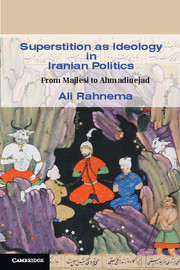
- Superstition as Ideology in Iranian PoliticsFrom Majlesi to Ahmadinejad, pp. 1 - 32Publisher: Cambridge University PressPrint publication year: 2011
References
Accessibility standard: Unknown
Why this information is here
This section outlines the accessibility features of this content - including support for screen readers, full keyboard navigation and high-contrast display options. This may not be relevant for you.Accessibility Information
Accessibility compliance for the PDF of this chapter is currently unknown
and may be updated in the future.