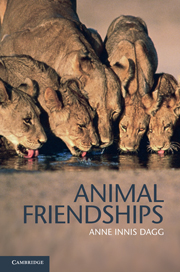
Book contents
- Frontmatter
- Contents
- Acknowledgments
- Introduction
- Male and female pals ??? not just for sex!
- In sisterhood
- In brotherhood
- Mothers and daughters
- Mothers and sons, and providing free food
- Fathers and sons, and social grooming and preening
- Family and group tight bonds
- Old buddies
- Social but seldom sociable animals
- Cross-species pals
- Animal and human ???friendships???
- References
- Notes
- Index
Introduction
Published online by Cambridge University Press: 05 October 2012

Book contents
- Frontmatter
- Contents
- Acknowledgments
- Introduction
- Male and female pals ??? not just for sex!
- In sisterhood
- In brotherhood
- Mothers and daughters
- Mothers and sons, and providing free food
- Fathers and sons, and social grooming and preening
- Family and group tight bonds
- Old buddies
- Social but seldom sociable animals
- Cross-species pals
- Animal and human ???friendships???
- References
- Notes
- Index
Summary
Every day for many years I watched our three female cats, Silver, Tiger, and Gomer. Silver and Tiger were best buddies but Gomer was a loner. Actually, Silver and Tiger were half-sisters, although how would they know this? Silver, named by my young daughter Mary (although the cat was black with a white throat patch) came first, as a kitten given to our family of five by friends who had a sexually too-active female. A year later they gave us Tiger, with gray tabby markings, also as a kitten. Silver cuddled and licked her new young friend as they snuggled together. But when full-grown, both ignored the calico cat Gomer who arrived at our house as an older adult. Gomer retaliated by hissing and striking out at them with her paws. Did Silver and Tiger know somehow that they were related, which cemented their lifelong bond? Was it because Tiger came as a kitten whom Silver could mother, while Gomer (also known fittingly as Crosspatch) did not? Is it impossible for cats to become friends as adults, even though they live for years together in the same house?
Because these cats daily reminded me that animal friendships have been under-studied and under-reported, I decided to make this my next book’s topic: not alliances involving youngsters that are highly instinctual – mothers and their nursing young or siblings growing up together; not matings between males and females that are short-term; but friendships between adult individuals in the wild, perhaps for evolutionary reasons or just because a duo has bonded and wants to spend much time together relaxing, feeding side by side, or grooming each other – and not all animals either, as at present we know little about the sensibilities of cold-blooded species. However, there is recent proof that three-spined stickleback fish recognize by olfaction and like to hang out with individuals from their own neighborhood (Ward et al., 2007), that lizards kept as pets can distinguish between different human family members (Lee Harding, personal communication, 2010), and that dominant male hissing cockroaches from Madagascar defend a territory against other males within which they court several females who are free to come and go as they wish (Bullington, no date). Perhaps in a few decades, after far more research has been done, we will have to acknowledge that, like birds and mammals, individuals of cold-blooded vertebrates and invertebrates can also have sophisticated social systems and special friendships.
Information
- Type
- Chapter
- Information
- Animal Friendships , pp. 1 - 17Publisher: Cambridge University PressPrint publication year: 2011
Accessibility standard: Unknown
Why this information is here
This section outlines the accessibility features of this content - including support for screen readers, full keyboard navigation and high-contrast display options. This may not be relevant for you.Accessibility Information
Accessibility compliance for the PDF of this chapter is currently unknown
and may be updated in the future.