Book contents
- Frontmatter
- Contents
- List of figures
- List of tables
- Notes on contributors
- Preface
- List of acronyms
- PART I overview of domestic support issues and WTO rules
- PART II Developed countries: have high levels of support come down?
- 3 European Union
- 4 United States
- 5 Japan
- 6 Norway
- PART III Developing countries: will low levels of support rise?
- PART IV Looking forward: can fair markets be achieved?
- Appendix A Domestic support provisions of the Agreement on Agriculture
- Appendix B Domestic support provisions of the Doha draft modalities
- Index
- References
4 - United States
Published online by Cambridge University Press: 11 April 2011

Book contents
- Frontmatter
- Contents
- List of figures
- List of tables
- Notes on contributors
- Preface
- List of acronyms
- PART I overview of domestic support issues and WTO rules
- PART II Developed countries: have high levels of support come down?
- 3 European Union
- 4 United States
- 5 Japan
- 6 Norway
- PART III Developing countries: will low levels of support rise?
- PART IV Looking forward: can fair markets be achieved?
- Appendix A Domestic support provisions of the Agreement on Agriculture
- Appendix B Domestic support provisions of the Doha draft modalities
- Index
- References
Summary
Domestic support for agriculture by the United States has proven to be contentious in the World Trade Organization and a center of attention in the Doha negotiations. The United States signaled its willingness to accept tighter disciplines on domestic support but insisted on a harmonization of support levels, in effect reducing allowable domestic support in the EU by a greater amount. The US position has also been to require significantly increased market access in other countries, including the emerging markets. In addition to the tension over the level of US domestic support in the Doha Round, several challenges under the WTO dispute settlement process have raised questions about whether the United States is correctly notifying its support to the WTO. Even without a Doha Round outcome, US domestic farm programs will be the subject of international scrutiny.
The first part of this chapter provides a brief review of the political economy of US farm policies, including a synopsis of the Food, Conservation, and Energy (FCE) Act of 2008. The following section discusses US domestic support notifications from 1995–2008. We then assess compliance with the Agreement, including an examination of subsidies that arguably are misclassified, underreported, or omitted from the notifications. The following section provides projections of US support through 2016. These projections are compared to existing support commitments and those proposed in the December 2008 Doha draft modalities.
Information
- Type
- Chapter
- Information
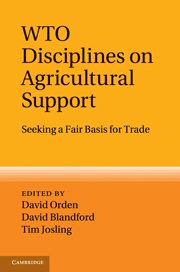
- WTO Disciplines on Agricultural SupportSeeking a Fair Basis for Trade, pp. 97 - 152Publisher: Cambridge University PressPrint publication year: 2011
References
, and . 2007. US and EU domestic support notifications, 2007–2012. Paper presented at a workshop of the German Marshall Fund of the United States, Washington, DC, September 11.
, , and . 2008. Implications for the United States. ICTSD/IPC/IFFPRI Project on Draft Agricultural Modalities. Paper presented at a seminar in Geneva, March 12.
2007. Farm bill budget and costs: 2002 vs. 2007. RS22694, Congressional Research Service. November 7.
. 2008. H.R. 2419: The Food, Conservation, and Energy Act of 2008 – Conference agreement compared to March 2007 CBO baseline, May 12. www.cbo.gov (accessed June 8, 2008).
, and . 2009. The economics of blend mandates for biofuels. American Journal of Agricultural Economics 91(3): 738–750.CrossRefGoogle Scholar
. 2002. American Agriculture in the Twentieth Century: How it Flourished and What it Cost. Cambridge, MA: Harvard University Press.Google Scholar
2009. Distortions to agricultural incentives in the United States and Canada. In Distortions to Agricultural Incentives: A Global Perspective 1955–2007, ed. . London: Palgrave Macmillan, and Washington, DC: World Bank.Google Scholar
, , and . 2009. CBO March 2009 baseline for CCC & FCIC, February 20. www.cbo.gov (accessed March 10, 2009).
., , and . 2010. Determinants of farm policies in the United States, 1996–2008. In The Political Economy of Distortions to Agricultural Incentives, ed. . Cambridge University Press.Google Scholar
, , and . 1999. Policy Reform in American Agriculture: Analysis and Prognosis. University of Chicago Press.Google Scholar
2005. Boxed in: Conflicts between US farm policies and WTO obligations. Trade Policy Analysis No. 32, CATO Institute.
. 2009a. Commodity Credit Corporation commodity estimates book FY 2010 mid-session review. Presentation 2010–02. Farm Service Agency, July.
2009b. USDA agricultural projections to 2017. Long-term projections report OCE-2008–1. Office of the Chief Economist, World Agricultural Outlook Board.
. 2005. United States – Subsidies on upland cotton. Report of the Appellate Body. WT/DS267/AB/R, 3 March.
2007a. United States – Domestic support and export credit guarantees for agricultural products. Request for the establishment of a panel by Brazil. WT/DS365/13, 9 November.
2007b. United States – Subsidies and other domestic support for corn and other agricultural products. Request for the establishment of a panel by Canada. WT/DS357/12, 9 November.
2008. Revised draft modalities for agriculture. TN/AG/W/4/Rev.4, 6 December.
, and . 2010. The Revenue program option in the 2008 US farm bill: Evaluating performance characteristics of the ACRE program. Agricultural and Resource Economics Review 39(3): 517–533.CrossRefGoogle Scholar
Accessibility standard: Unknown
Why this information is here
This section outlines the accessibility features of this content - including support for screen readers, full keyboard navigation and high-contrast display options. This may not be relevant for you.Accessibility Information
Accessibility compliance for the PDF of this chapter is currently unknown
and may be updated in the future.
- 4
- Cited by