Book contents
- Frontmatter
- Contents
- Acknowledgments
- 1 Framing American Foreign Policy
- 2 The Intellectual Context of American Foreign Policy
- 3 Islam and Muslims in the Mind of America
- 4 The Carter, Reagan, and Bush Administrations' Approach to Islamists
- 5 The Clinton Administration: Co-opting Political Islam
- 6 The Islamic Republic of Iran
- 7 Algeria
- 8 Egypt
- 9 Turkey
- 10 Conclusion
- References
- Index
6 - The Islamic Republic of Iran
Published online by Cambridge University Press: 05 June 2012

Book contents
- Frontmatter
- Contents
- Acknowledgments
- 1 Framing American Foreign Policy
- 2 The Intellectual Context of American Foreign Policy
- 3 Islam and Muslims in the Mind of America
- 4 The Carter, Reagan, and Bush Administrations' Approach to Islamists
- 5 The Clinton Administration: Co-opting Political Islam
- 6 The Islamic Republic of Iran
- 7 Algeria
- 8 Egypt
- 9 Turkey
- 10 Conclusion
- References
- Index
Summary
Few foreign-policy relationships evoke as much anger and emotion in the United States as does the U.S. relationship with Iran. Although U.S.-Iranian relations were poor in 1979, they have reached their nadir under the Clinton administration. Unlike some of its predecessors, this administration has decided to confront rather than co-opt postrevolutionary Iran. Since 1995, the Clinton administration has waged an undeclared economic, political, and covert war against Iran's cleric-dominated regime.
In contrast to its general statements on political Islam that are accommodationist, the Clinton administration's discourse on Iran is exceptionally hostile, as are its actions toward that country. In the Iranian context, U.S. rhetoric serves as a gauge to policy. Iran thus makes an ideal case study from which one can examine U.S. thinking and action toward revolutionary Islam, despite American policy makers' efforts to downplay the Islamic factor behind Iranian behavior.
Culture or Security?
From the outset of the Clinton presidency, administration officials have expressed deep objections to Iran's policies, branding it an “international outlaw,” “terrorist,” and “rogue” state. U.S. officials have made no secret of their plan to isolate and contain Teheran in order to force it to change its threatening behavior. Iran's policies, stated Clinton, include its active opposition to the Arab-Israeli peace process, its support of local and international terrorism, and its quest to acquire nuclear weapons. The result is that Iran has become “a threat not only to its neighbors, but to the entire region and the world.”
Secretary of State Christopher echoed Clinton's sentiment: “We view Iran's action as a major threat to United States interests and international security, and we're determined to stop them.”
Information
- Type
- Chapter
- Information
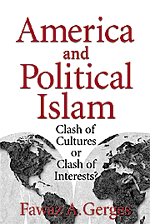
- America and Political IslamClash of Cultures or Clash of Interests?, pp. 115 - 142Publisher: Cambridge University PressPrint publication year: 1999
Accessibility standard: Unknown
Why this information is here
This section outlines the accessibility features of this content - including support for screen readers, full keyboard navigation and high-contrast display options. This may not be relevant for you.Accessibility Information
Accessibility compliance for the PDF of this chapter is currently unknown
and may be updated in the future.